




A maintenance supervisor at a Latonia facility opens a storage room and finds a pallet of spent fluorescent lamps, two boxes of used lithium batteries, and a shelf of old acids and oxidizers left over from a lab cleanout. For businesses that need hazardous waste disposal in Covington, KY, that room is a familiar problem, because none of it can go in the dumpster and each item falls under a different set of rules.
Specific Waste Industries (SWI) has spent more than 45 years helping facilities sort out exactly this kind of situation. We’re regionally owned and operated, and we serve Covington and the rest of Northern Kentucky. SWI provides an assessment, picks up at your facility’s chosen frequency, and safely transports hazardous waste for proper disposal, with paperwork at every step. When you’re ready to see what a program would look like for your site, request a quote.
Hazardous Waste We Pick Up From Covington Businesses
Most Covington facilities generate more than one kind of hazardous waste, and some of it, like spent lamps and old batteries, sits unnoticed until a storage closet fills up. Each category comes with its own packaging and handling rules, so SWI reviews every stream before the first pickup. The categories below cover what we collect and transport for proper disposal.
Universal Waste
Offices, schools, and maintenance shops that never touch a drum of chemicals still generate universal waste. SWI picks up the following.
- mercury-containing fluorescent lamps
- batteries, including lithium-ion, lithium metal, lead-acid, nickel-cadmium, nickel-metal hydride, alkaline, and button batteries
- consumer electronics, including computers, keyboards, monitors, cell phones, and circuit boards
Universal waste rules are simpler than full hazardous waste rules, but only while lamps stay intact and batteries stay contained. Our guide to fluorescent lamp disposal covers storage in more detail.
Pharmaceutical Waste
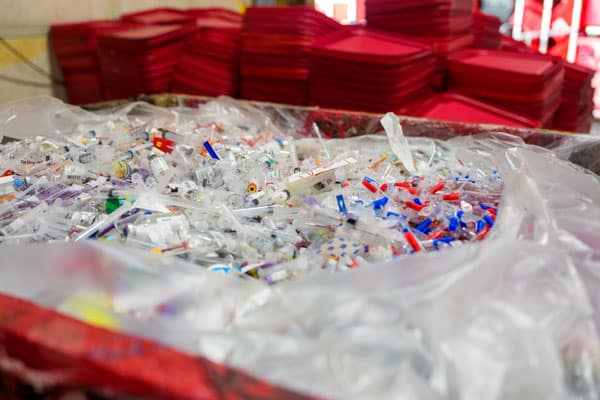
SWI collects non-hazardous pharmaceutical waste, hazardous pharmaceutical waste, and controlled substances. Blue containers hold pharmaceutical waste, and black containers hold hazardous waste, which includes hazardous pharmaceuticals. For clinics, pharmacies, and veterinary practices, our pharmaceutical waste disposal services explain how we handle each group.
Inorganic and Mercury Waste
Inorganic waste covers acids, bases, aqueous waste with heavy metals, and oxidizers. It usually comes from labs, manufacturers, and maintenance departments.
Mercury waste includes thermostats, thermometers, mercury switches, mercury-contaminated debris, chemical oxygen demand (COD) vials, and elemental mercury. Renovating older commercial buildings, like many downtown and in Mainstrasse Village, can uncover mercury thermostats and switches that must be removed before demolition starts.
Other Hazardous Waste
SWI also picks up contaminated gasoline and diesel, aerosol cans, organic peroxides, water-reactive and pyrophoric waste, and compressed gas cylinders.
Non-Hazardous Waste We Also Handle
Some streams aren’t hazardous but still can’t go in the regular trash. SWI collects antifreeze, used oil, oily water, non-PCB ballasts, PCB ballasts (non-TSCA regulated), non-hazardous oil and absorbents, RCRA empty drums, and industrial non-hazardous and special waste. RCRA empty drums are containers that count as empty under the federal Resource Conservation and Recovery Act (RCRA). Using one vendor to handle regulated and non-regulated streams means fewer pickups for your team to coordinate.
What Makes Waste Hazardous in Kentucky
Before packaging and pickup, someone must determine whether the waste is hazardous in the first place. Waste is hazardous if the U.S. Environmental Protection Agency (EPA) lists it by name, or if it’s toxic, ignitable, corrosive, or reactive. Kentucky adopts the federal definitions, so the same tests apply in Covington as anywhere else in the country.
Each of the four characteristics has a defined test.
- Toxic: Waste that could leach regulated metals or chemicals above set limits in a lab test.
- Ignitable: Liquids with a flash point below 140°F, such as gasoline and some solvents.
- Corrosive: Waste with a pH of 2 or lower, or 12.5 or higher, such as strong acids and bases.
- Reactive: Waste that’s unstable, reacts violently with water, or can release toxic gases.
EPA also lists specific wastes by name in four groups: F, K, P, and U. P-listed wastes are acutely hazardous, so even small amounts count toward much lower monthly limits. If you’re sorting out the terms, our article on toxic waste vs. hazardous waste explains how they differ.
Who Decides Whether Waste Is Hazardous
The generator does. Federal rules make the business that produces the waste responsible for deciding whether it’s hazardous, based on knowledge of the materials and process, a safety data sheet (SDS), or lab testing. Small and large quantity generators keep records of those decisions for at least three years.
During the waste review, SWI goes over SDSs and process details with your team. That conversation helps ensure each stream is identified and packaged correctly before pickup, while your facility retains the determination.
Kentucky Hazardous Waste Rules for Covington Businesses
Once a waste is identified as hazardous, the next question is about which rules your facility must follow. Kentucky runs its own hazardous waste program under federal authorization from EPA, and the Energy and Environment Cabinet’s Division of Waste Management (DWM) manages it. Most Kentucky hazardous waste regulations follow RCRA, although the state adds its own registration, reporting, and fee requirements. What a Covington facility has to do depends mostly on how much hazardous waste it generates each month.
Which Generator Category Fits Your Facility
| Very small quantity generator (VSQG) | Small quantity generator (SQG) | Large quantity generator (LQG) | |
| Hazardous waste per month | 100 kg (220 lb) or less | More than 100 kg, less than 1,000 kg | 1,000 kg (2,200 lb) or more |
| Acute hazardous waste per month | 1 kg or less | 1 kg or less | More than 1 kg |
| Maximum on site | 1,000 kg | 6,000 kg | No limit |
| Time limit on site | None below 1,000 kg | 180 days (270 if the receiving facility is 200+ miles away) | 90 days |
| Emergency preparedness | Not required | An emergency coordinator on call, and basic emergency information posted | A written contingency plan and an emergency coordinator |
| Staff training | Not required | Staff familiar with handling and emergency procedures | Formal training program with yearly review |
A two-chair dental office or a small auto shop is usually a VSQG. A hospital, manufacturer, or university lab may move between categories from month to month, and an episodic event, such as a one-time cleanout, can temporarily change a facility’s status.
Registration, EPA ID Numbers, and Annual Reports
Generators that need an EPA ID number register with DWM by filing EPA Form 8700-12 and Kentucky’s addendum, DWM 7037A, online through eForm #108. Kentucky requires annual renewal, and changes must be reported within 30 days.
SQGs and LQGs also file a Kentucky annual report, due January 1. VSQGs generally don’t file one unless they were an SQG or LQG at any point during the year. Filing every year is more frequent than the biennial report required under federal rules, a difference that’s easy to miss if you’ve worked in another state.
In addition to registration, Kentucky charges an annual hazardous waste assessment on Form DEP 7070. It’s based on the pounds of waste generated, at different rates for liquids and solids, and state law sets it through June 30, 2032. When a site stops generating hazardous waste, Kentucky expects a closure notice on Form DWM 7086 within 90 days.
Manifests and Shipping Records
Every generator that ships hazardous waste off site uses the Uniform Hazardous Waste Manifest, which tracks the waste from your facility to the receiving facility. EPA’s electronic system, e-Manifest, has been live since June 30, 2018, and paper manifests are still accepted.
Keep each manifest for three years from the date the transporter accepted the waste. You’ll also want to keep the one-time land disposal restriction notice that goes out with the first shipment of each waste stream.
Universal Waste Rules in Kentucky
Kentucky follows the federal universal waste categories, which include batteries, lamps, mercury-containing equipment, pesticides, and aerosol cans. Kentucky allows universal waste to be stored for up to one year.
One Kentucky rule deserves extra attention: Breaking or crushing universal waste lamps turns them into hazardous waste, so lamps should be stored intact in closed boxes until pickup.
Pharmaceutical Waste and the Sewer Ban
Since August 21, 2019, healthcare facilities nationwide have been barred from flushing hazardous waste pharmaceuticals or pouring them down a drain. Kentucky has adopted EPA’s hazardous waste pharmaceutical rules, though EPA hasn’t yet authorized the state to run them.
At a Covington clinic, pharmacy, or veterinary practice, that means expired or unused medications go into a blue or black container for pickup and never down the sink or toilet.
Moving Hazardous Waste Safely
Once hazardous waste leaves your building, it falls under both EPA rules and U.S. Department of Transportation (DOT) hazardous materials rules. Transporters need an EPA ID number, and every load has to be labeled, marked, and placarded correctly. Kentucky also requires certain releases to be reported. SWI’s trained staff and DOT-compliant vehicles handle each pickup.
How Hazardous Waste Pickup Works in Covington
Knowing the rules is one part of compliance, and getting waste out of the building correctly is the other. Every SWI program follows the same five steps, whether your facility needs weekly service or a single pickup after a cleanout. Keeping the steps consistent means your staff knows what to expect and your records stay complete.
- Waste review: SWI looks at what your facility generates, how much, and your current generator category. Having SDSs ready for unfamiliar chemicals speeds this up.
- Program setup: SWI builds a program around your waste streams and volume and gives you a clear quote.
- Pickup frequency: You choose how often SWI collects.
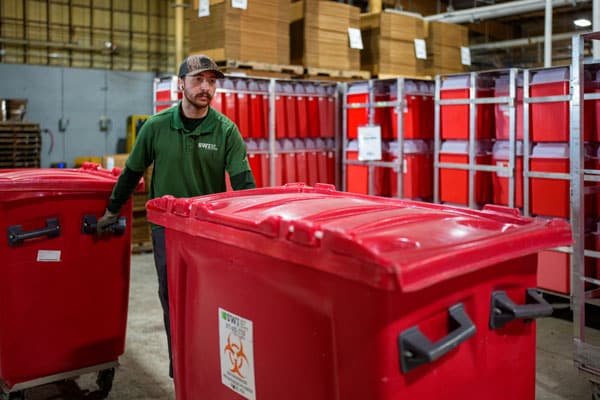
- Collection and transport: Trained SWI staff collect the waste at your facility and transport it in DOT-compliant vehicles under a hazardous waste manifest.
- Proper disposal and records: The waste goes to a permitted facility for proper disposal, and your facility receives the manifest copies it needs for its records.
Choosing a Pickup Frequency
SWI offers daily, weekly, bi-weekly, monthly, bi-monthly, quarterly, annual, and one-time hazardous waste pickup. An LQG working against its 90-day limit may need weekly or monthly service. An office building that only collects lamps and batteries may be well served by quarterly or annual visits.
One-time pickups suit lab cleanouts, renovations, and facility closures. If you’re closing a site, remember that Kentucky expects a closure notice within 90 days of the last hazardous waste generated there.
What to Have Ready for a Quote
A few details make the first conversation faster and the quote more accurate.
- Waste types: A list of what you need removed, with SDSs for any chemicals.
- Approximate amounts: Rough monthly volume, or the total for a one-time cleanout.
- Container photos: Photos of the existing containers and their labels, which help identify older or unlabeled materials.
- Generator status: Your EPA ID number and current category, if you have them.
Keeping Hazardous Waste Compliant Between Pickups
Most of the day-to-day compliance work happens between pickups, in how waste is stored, labeled, and checked on the shop floor or in the lab. That work usually falls to maintenance staff, lab technicians, or medical assistants in the middle of a busy shift, so the routines need to be simple and consistent. The guidance below covers the storage basics, what to do after a spill, and the mistakes that cause the most trouble.
Labeling and Storage Basics
Federal accumulation rules set out a handful of basics for storing hazardous waste on site.
- Labels: Mark each container “Hazardous Waste,” identify the hazard, and write the date accumulation started.
- Closed containers: Keep lids closed except when you’re adding or removing waste.
- Satellite accumulation: Up to 55 gallons of hazardous waste, or 1 quart of acute hazardous waste, can be kept at or near the point where it’s generated, under the control of the operator.
- Weekly checks: SQGs and LQGs inspect central storage areas every week for leaks and damage.
- Headroom in liquid containers: Don’t fill liquid waste drums to the brim. Leave room for expansion.
If Something Spills
Contain the spill if it’s safe to do so, and follow your facility’s emergency procedures. At an SQG or LQG, that includes calling the emergency coordinator. Kentucky requires reporting certain releases to the Energy and Environment Cabinet’s 24-hour environmental emergency line, followed by a written report within seven days. Post the current number near your storage area so no one has to search for it.
Common Mistakes That Cause Problems
These five issues come up repeatedly, and each one is easy to prevent once staff knows to watch for it.
- Mixing incompatible waste: Acids, oxidizers, and organic peroxides can react when stored together, so keep each stream in its own container.
- Crushed lamps: A broken lamp box is no longer universal waste in Kentucky.
- Loose lithium batteries: Tape the terminals or bag batteries individually to prevent short circuits.
- Medications down the drain: The sewer ban applies to every healthcare facility.
- Missing manifests: Keep the returned copy for three years, the federal retention period.
Why Businesses Choose Specific Waste Industries
Covington facilities have several hazardous waste removal options, and most providers promise pickup and compliance. The differences often show up in the details, such as how quotes are built, how much experience backs each program, and whether service can adjust when volume changes. These are the reasons businesses work with SWI.
45+ Years of Waste Compliance Experience
SWI has spent more than 45 years working with hazardous, universal, pharmaceutical, and medical waste, along with the EPA, DOT, Occupational Safety and Health Administration (OSHA), and state rules that govern each one. Our primary goal is to keep your facility compliant and protected from fines and liability. We also offer OSHA compliance training so your staff can handle waste correctly between visits.
Upfront Quotes and No Hidden Fees
Your quote reflects your waste types, volume, packaging, and pickup frequency. That keeps pricing competitive and transparent, and invoices stay straightforward with no surprise charges.
One Regional Partner for Every Waste Stream
Many Covington facilities produce several kinds of waste. A clinic or lab can work with SWI for hazardous, pharmaceutical, and medical waste, along with medical document shredding. SWI treats medical and chemotherapy waste with high heat at its own facility, and transports hazardous waste for proper disposal.
Programs Sized for Your Facility
Because SWI is regionally owned and operated, we build each program around the facility it serves. An LQG gets a program sized for its volume, and a small shop gets one sized for its own. National providers often work from fixed templates that leave little room to adjust when a facility’s needs change. If you manage more than one Northern Kentucky site, mention it when you request a quote.
Covington Businesses and the Waste They Generate
The hazardous waste a facility produces depends on the work it does every day. Covington’s mix of hospitals and clinics, labs and production space in Latonia and South Covington, and a dense downtown of offices and shops generates a wide range of streams.
- Hospitals, surgery centers, and clinics: Hazardous and non-hazardous pharmaceutical waste, controlled substances, mercury thermometers and devices, and batteries.
- Clinical, research, and university laboratories: Acids, bases, oxidizers, aqueous waste with heavy metals, and COD vials.
- Dental and veterinary practices: Pharmaceutical waste and mercury-containing devices.
- Pharmacies: Expired and returned pharmaceutical waste.
- Manufacturers and production facilities: Inorganic waste, organic peroxides, aerosol cans, compressed gas cylinders, and used oil.
- Auto repair, fleet maintenance, and dealership service departments: Used oil, oily water, antifreeze, contaminated gasoline and diesel, and lead-acid batteries.
- Property managers and facility maintenance teams: Fluorescent lamps, ballasts, batteries, and mercury thermostats and switches.
- Offices and IT departments: Computers, monitors, cell phones, and other consumer electronics.
- Schools, colleges, and municipal facilities: Lab chemicals, universal waste, and maintenance-shop waste.
Hazardous Waste Pickup Across Covington and Northern Kentucky
SWI’s Northern Kentucky service area starts in Covington and extends into Kenton, Campbell, and Boone counties. Facilities across the region get the same programs, containers, and pickup frequency options as businesses inside city limits.
SWI provides hazardous waste pickup throughout Covington, including ZIP codes 41011, 41014, and 41015, which cover downtown and the riverfront, Mainstrasse Village, Latonia, Wallace Woods, Licking Riverside, Peaselburg, and South Covington.
Elsewhere in Kenton County, we serve Ludlow (41016), Fort Mitchell, Lakeside Park, and Edgewood (41017), along with Erlanger, Fort Wright, Park Hills, Taylor Mill, and Independence. Our Northern Kentucky coverage also reaches Newport, Bellevue, Dayton, and Fort Thomas in Campbell County, plus Florence and Hebron in Boone County. For nearby areas, see our pages on hazardous waste disposal in Florence, Boone County hazardous waste disposal, Cincinnati hazardous waste disposal, and hazardous waste disposal in Kentucky.
Other Waste Services From SWI
Hazardous waste is often one of several regulated streams a Covington facility manages. Clinics and labs in particular tend to generate medical waste, sharps, and patient records alongside chemicals and batteries, and each needs its own compliant route. SWI also provides the following services.
- Medical waste disposal: Scheduled pickup, with medical waste treated with high heat at SWI’s own facility. Learn more about medical waste disposal in Covington.
- Sharps disposal: Scheduled pickup of used sharps. See sharps disposal in Covington.
- Sharps mail-back: A mail-back program for sharps only, available nationwide and well-suited to remote locations, acupuncture clinics, and tattoo parlors.
- Medical document shredding: Secure shredding for medical documents. See medical document shredding in Covington.
- OSHA compliance training: OSHA compliance training that prepares staff to handle regulated waste correctly.
Request a Hazardous Waste Disposal Quote in Covington
A quote from SWI is built on your actual waste streams, volume, and pickup frequency. Having your waste list, rough amounts, and generator status on hand will speed things up. Call Specific Waste Industries at (877) 425-2770 or request a quote online. Live operators are available Monday through Friday, 8 a.m. to 5 p.m. EST.
Frequently Asked Questions
Pricing depends on the type of waste, the amount, packaging requirements, and how often you need pickups. SWI offers competitive, transparent pricing, and invoices are straightforward with no hidden fees. Because every facility’s mix of waste is different, the most accurate way to get a figure is to request a quote based on what you actually generate.
SQGs and LQGs need an EPA ID number before shipping hazardous waste off site. In Kentucky, that means registering with DWM through eForm #108 and renewing the registration every year. VSQGs generally don’t need one unless they have an episodic event or choose to register.
Count the hazardous waste your facility generates in a calendar month, not the amount it ships. Each month’s total sets your category for that month, so a busy month or a large cleanout can temporarily move you up a category. The generator category table above shows the monthly limits for each one.
LQGs can store hazardous waste for up to 90 days, and SQGs for up to 180 days, or 270 days if the receiving facility is more than 200 miles away. VSQGs have no time limit as long as they stay under 1,000 kg on site. Universal waste can be stored for up to one year.
Your facility gets a copy of the hazardous waste manifest when the waste leaves, and the receiving facility returns a signed copy once it accepts the shipment. Keep both for three years, along with any land disposal restriction notices, and file them with your other compliance records so they’re easy to find during an inspection.
Yes. All three are universal waste, and SWI collects them. That includes lithium-ion, lithium metal, lead-acid, nickel-cadmium, nickel-metal hydride, alkaline, and button batteries, as well as computers, monitors, and cell phones. Keep lamps intact in closed boxes, since crushed lamps become hazardous waste in Kentucky.
Some of it is. Pharmaceutical waste falls into three groups, which are non-hazardous, hazardous, and controlled substances. Blue containers hold pharmaceutical waste, and black containers hold hazardous waste, including hazardous pharmaceuticals. Under the federal sewer ban, none of it can be flushed or poured down a drain at a healthcare facility.
Containers can be purchased through us or through another vendor, but they are not provided free of charge. SWI recommends the following color code for containers: Red for medical waste, yellow for chemotherapy waste, blue for non-hazardous pharmaceutical waste, and black for hazardous waste. For sharps and medical waste containers, OSHA recommends changing them when they’re ¾ full.
Yes, one-time service works well for lab cleanouts, renovations, and site closures. If a closure means your facility will stop generating hazardous waste, Kentucky expects a closure notice within 90 days of the last waste generated, so it helps to plan the final pickup with that deadline in mind.
Kentucky law allows civil penalties of up to $25,000 per day of violation, and known violations can be prosecuted as a felony. Most problems are avoidable with correct labeling, storage within the time limits for your generator category, and complete manifest records, all of which are covered in the Kentucky rules section above.
SWI also provides Cincinnati hazardous waste disposal. Companies with sites on both sides of the Ohio River deal with two state programs, Kentucky DWM and Ohio EPA, and working with one regional provider keeps pickups and records consistent across locations.