



Choosing a medical waste disposal provider in Covington, KY, comes down to one question: who keeps your facility compliant once the red bags, sharps, and expired medications leave your hands? Specific Waste Industries (SWI) has made that its primary goal for more than 45 years. As a regionally owned and operated company, we work with physician offices, dental practices, surgery centers, veterinary clinics, and other healthcare facilities across Covington and Northern Kentucky. Every program starts with containers, which SWI provides. You set the pickup frequency, our team handles medical waste pickup and transport, and medical waste is treated with high heat at our own facility. To see what that would look like for your site, request a quote.
Medical Waste We Collect From Covington Facilities
A single Covington clinic can produce four or five distinct waste streams in a normal week, and each one is handled differently once it leaves the building. Sorting starts at the point of use, so SWI recommends color-coded containers that make the right choice obvious to whoever is standing at the exam table or lab bench. Here’s how those containers break down.
Red Containers for Regulated Medical Waste and Sharps
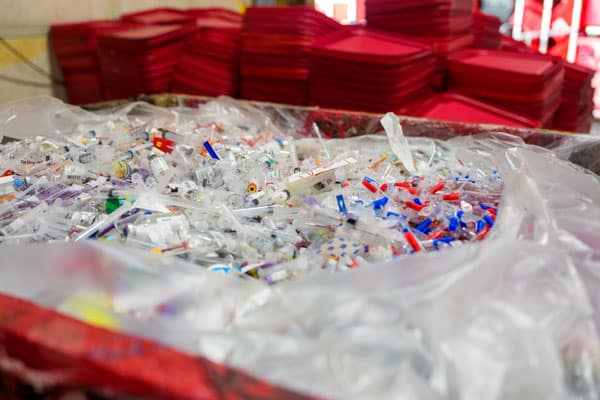
Red-bag containers hold potentially infectious waste, which some office managers call biohazard waste. The following items belong in them.
- blood and blood products
- used blood tubes
- cultures and stocks from laboratory work
- isolation waste
- gauze, gloves, and other disposables contaminated with blood or other potentially infectious materials
Used needles, lancets, scalpels, and other sharps go in puncture-resistant sharps containers. Veterinary clinics generate their own version of this waste, including contaminated sharps and blood from animal patients. SWI treats all of it with high heat at our own facility. The Occupational Safety and Health Administration (OSHA) recommends changing containers when they’re ¾ full, since crowded openings are where needlestick injuries tend to happen.
Separate Containers for Pathological Waste
Pathological waste covers human tissue, organs, and body parts from surgical, pathology, and autopsy settings. It’s packaged apart from other medical waste and treated with high heat. Most Covington family practices will never produce it, although surgery centers and hospital departments generate it regularly.
Yellow Containers for Chemotherapy Waste
Trace chemotherapy waste goes in yellow containers and is treated with high heat. Think empty vials, IV bags and tubing, gloves, gowns, and anything else used to prepare or give chemotherapy drugs. Partly full vials and spill cleanup materials may count as hazardous waste, so they belong in a black container.
Blue and Black Containers for Pharmaceutical Waste
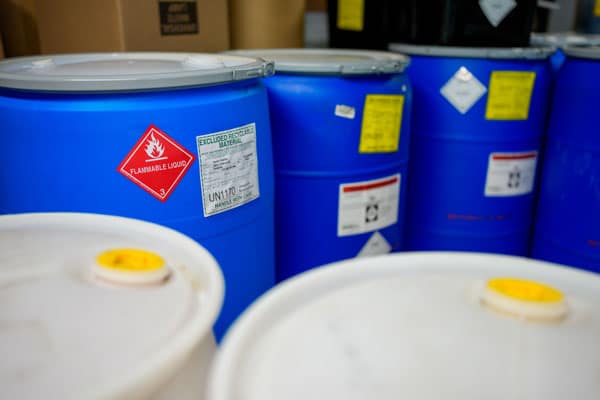
Non-hazardous pharmaceutical waste goes in blue containers, while hazardous pharmaceutical waste and other hazardous waste go in black ones. Controlled substances fall under Drug Enforcement Administration (DEA) rules and are handled as a separate category, so don’t add them to either container without guidance. We transport all pharmaceutical waste for proper disposal. For more detail, see our pharmaceutical waste disposal services.
How Kentucky Regulates Medical Waste
No single Kentucky agency regulates medical waste. Oversight is divided among health facility licensing rules, the state’s workplace safety program, solid waste rules, and federal transport requirements. Which of those apply to a Covington practice depends on the facility type, so it helps to review each piece separately.
Health Facility Rules Under 902 KAR 20
Kentucky’s Cabinet for Health and Family Services licenses hospitals, nursing facilities, ambulatory surgical centers, and several types of clinics under the 902 KAR 20 series of regulations. Facilities covered by these rules must keep sharps separate from other waste and have specified waste treated before final disposal so it’s no longer infectious.
The hospital rule, 902 KAR 20:016, shows how detailed those requirements can be. Under it, a Kentucky hospital must:
- keep written policies for handling and disposing of waste
- place sharps in puncture-resistant containers right after use
- never bend, break, or otherwise manipulate a contaminated needle by hand as a way of disposing of it
- give blood products, microbiology lab waste, and pathological waste special handling, with pathological waste treated with high heat
Surgery centers, nursing homes, and other licensed facility types each have their own section in the 902 KAR 20 series, and it’s worth reading the one written for your license. Treatment is also crucial, as most sanitary landfills in Kentucky won’t take medical waste that hasn’t been treated first.
Kentucky OSH and the Bloodborne Pathogens Standard
Kentucky runs its own OSHA-approved state plan, Kentucky Occupational Safety and Health (Kentucky OSH), which covers private employers along with state and local government workplaces. In Covington, it’s the agency enforcing the bloodborne pathogens standard.
That standard sets clear container requirements. Sharps containers must be closable, puncture-resistant, leakproof on the sides and bottom, labeled or color-coded, kept upright during use, and replaced before they overfill. Other regulated waste goes in closable, leak-resistant containers that are labeled or red.
Inspectors also tend to ask for two documents. One is a written exposure control plan, reviewed and updated at least once a year. The other is a record of bloodborne pathogens training for exposed staff, provided at hire and renewed annually. SWI offers OSHA compliance training to help your team keep both current.
Hauling and Transport Requirements
Federal Department of Transportation (DOT) rules take over once regulated medical waste leaves your building. In transport, it’s classified as a Division 6.2 hazardous material (UN3291), with specific requirements for packaging, marking, and shipping papers.
Kentucky adds a county-level layer. Haulers of municipal solid waste, including medical waste haulers, must register with each county where they do business and report annually. That makes it fair for a Covington facility to ask any vendor whether it’s registered in Kenton County.
Pharmaceutical Waste and the Sewer Ban
Since August 21, 2019, healthcare facilities nationwide have been prohibited from flushing hazardous waste pharmaceuticals or pouring them down a drain. Kentucky has adopted the U.S. Environmental Protection Agency (EPA) pharmaceutical rules known as Subpart P, although EPA hasn’t yet authorized the state to run them.
At the clinic level, the rule is simple: Expired or unused medications go into a pharmaceutical waste container for pickup. Sinks, toilets, regular trash, and red bags are all off limits.
How Medical Waste Pickup Works in Covington
Setting up service with SWI starts with a review of what your facility generates and how quickly its containers fill. From there, the program runs at the frequency you pick, and every pickup follows the same five steps.
- Program review: SWI looks at the waste streams your facility produces and the volume of each.
- Pickup frequency: You choose how often SWI collects.
- Collection: Trained SWI staff collect the waste at your facility at the frequency you chose.
- Transport: Waste travels in DOT-compliant vehicles. SWI transports medical and chemotherapy waste to its own treatment facility, and pharmaceutical and hazardous waste for proper disposal.
- Treatment and documentation: SWI treats medical and chemotherapy waste with high heat, and your facility receives the paperwork it needs for its records.
Choosing a Pickup Frequency
SWI offers daily, weekly, bi-weekly, monthly, bi-monthly, quarterly, annual, and one-time medical waste pickup. A dialysis center or hospital department may need service daily or weekly. On the other end, a small dental office or a counseling practice that only produces sharps may need a visit once a month or once a quarter. You can adjust frequency as volume shifts, and one-time pickups work well for office cleanouts, closures, and moves.
Keeping Waste Compliant Between Pickups
Pickup day gets most of the attention, but compliance is decided in the weeks between visits. That’s when medical assistants and front desk staff make dozens of small calls about which container to use. A few consistent habits keep waste in the right place and keep regulated volume under control.
Common Sorting Mistakes
The same four mistakes show up in busy practices again and again. Each one is easy to fix once staff knows to look for it.
- Red bags used as general trash: Paper towels, wrappers, and other non-contaminated waste often land in red bags. That inflates your regulated volume, and because pricing reflects volume, it raises your cost too.
- Medications in red containers: Expired drugs belong in a pharmaceutical container. Red containers aren’t designed for them.
- Overfilled sharps containers: Swap the container when it reaches the ¾ line, and never push sharps down to make room.
- Patient paperwork in waste containers: Labeled forms, charts, and printouts carry patient information and should go to medical document shredding in Covington.
Storing Full Containers Until Pickup
Close full containers, keep them upright, and store them where staff can reach them but patients and visitors can’t. Many practices use a utility room or a locked closet for this. Keeping regulated waste apart from regular trash and recycling prevents mix-ups when it’s time to haul everything out.
Why Covington Facilities Choose Specific Waste Industries
Several medical waste removal companies advertise service in Covington, and most of them promise pickup and compliance. What sets them apart is often less visible, such as who owns the treatment step and whether a program can be resized for a small practice. These are the reasons facilities here work with SWI.
45+ Years in Medical Waste Compliance
SWI has spent more than 45 years working with medical, chemotherapy, pathological, pharmaceutical, and hazardous waste, along with the OSHA, EPA, DOT, and state rules that govern each one. Keeping your facility compliant is our primary goal. The SWI staff who arrive for each pickup are trained in the packaging and transport rules for regulated waste.
In-House Medical Waste Treatment
SWI treats medical waste collected at our facility with high heat. Because we own that step of the process, we can offer competitive pricing on medical waste disposal.
Transparent Pricing With No Hidden Fees
Your quote is based on your waste types, volume, and pickup frequency. Invoices are straightforward, with no hidden fees or surprise charges.
A Regional Partner for Northern Kentucky
Being regionally owned and operated means each SWI program is built around the facility it serves. A large-quantity generator gets a program sized for its volume, and a two-provider practice gets one that fits its own. National providers often rely on fixed templates, which leave little room to adjust when a facility’s needs change.
Covington Healthcare Facilities We Serve
Healthcare in Covington stretches well beyond the St. Elizabeth Covington campus. Across Kenton County, independent clinics, specialty offices, animal hospitals, and tattoo studios each generate regulated waste on their own schedule. SWI provides medical waste disposal for the following facility types.
- hospitals and outpatient centers
- physician and specialty practices
- dental and orthodontic offices
- urgent care and walk-in clinics
- surgery centers
- dialysis centers
- laboratories and imaging centers
- nursing homes and assisted living facilities
- home health and hospice agencies
- pharmacies
- veterinary clinics
- funeral homes
- tattoo and piercing studios
Serving Covington and Northern Kentucky
SWI’s Northern Kentucky service area starts in Covington and extends across Kenton, Campbell, and Boone counties. Within the city, we provide medical waste pickup in ZIP codes 41011, 41014, and 41015, which cover downtown Covington, MainStrasse Village, Latonia, Wallace Woods, Peaselburg, Licking Riverside, and South Covington.
Elsewhere in Kenton County, we serve Ludlow (41016), Fort Mitchell, Lakeside Park, and Edgewood (41017), Erlanger (41018), Fort Wright, Park Hills, Taylor Mill, and Independence. Our coverage also includes Newport, Bellevue, Dayton, and Fort Thomas in Campbell County, plus Florence in Boone County. For nearby areas, see our pages on medical waste disposal in Florence, Boone County medical waste disposal, Cincinnati medical waste disposal, and medical waste disposal in Kentucky.
Other Waste Services for Covington Facilities
Medical waste pickup is often the first service a Covington facility sets up with SWI, though rarely the last. Sharps, hazardous materials, and patient records each need their own compliant route, and using one provider for all four keeps your vendor list short. SWI also provides the following services in Covington:
- Sharps disposal: Scheduled pickup of used needles and other sharps.
- Sharps mail-back: A sharps mail-back program for sharps only, available nationwide and well suited to remote locations, acupuncture clinics, and tattoo parlors.
- Hazardous waste disposal: Waste that’s toxic, ignitable, corrosive, or reactive is safely transported for proper disposal. That includes universal waste such as batteries and mercury-containing fluorescent lamps, mercury waste, and inorganic waste such as acids and bases. Learn more about hazardous waste disposal in Kentucky.
- Medical document shredding: Secure shredding for medical documents. See medical document shredding in Covington.
- OSHA compliance training: OSHA compliance training that prepares staff to handle regulated waste correctly and get ready for inspections.
Request a Medical Waste Disposal Quote in Covington
SWI builds a quote on your actual waste streams, volume, and pickup frequency, so the number reflects your facility. Our team will review what you generate and recommend a program that meets your compliance needs. Call Specific Waste Industries at (877) 425-2770 or request a quote online. Live operators are available Monday through Friday, 8 a.m. to 5 p.m. EST.
Frequently Asked Questions
Pricing depends on the types of waste your facility produces, the volume of each, and how often you need pickups. SWI offers competitive, transparent pricing, straightforward invoices, and no hidden fees. Keeping non-contaminated trash out of red bags also helps, since regulated volume drives cost. For an exact figure, request a quote.
We review agreement terms with you when you request a quote. Every SWI program is tailored to the facility it serves, so your waste streams, volume, and pickup frequency shape what you sign up for. You’ll know exactly what’s included before service begins.
Share your current waste types, volume, and pickup frequency with our team, and SWI will build a program and quote around that information. Once you’re ready to move forward, we coordinate container delivery ahead of your first pickup so there’s no gap in service.
Medical waste is potentially infectious material, such as blood, sharps, and cultures, and SWI treats it with high heat. Hazardous waste is toxic, ignitable, corrosive, or reactive, and it’s transported for proper disposal. Some items, including bulk chemotherapy waste and certain pharmaceuticals, can fall under hazardous waste rules.
Untreated regulated medical waste from a healthcare facility should never go in a regular dumpster. The bloodborne pathogens standard requires containment and labeling, and Kentucky’s health facility rules require treating sharps and certain other waste before disposal. Most Kentucky landfills won’t accept untreated medical waste.
OSHA recommends changing sharps containers when they’re ¾ full. The bloodborne pathogens standard also requires routine replacement and prohibits overfilling. High-use exam rooms and procedure areas may need a second container or more frequent pickups.
Containers can be purchased through us or through another vendor, but they are not provided free of charge. SWI recommends the following color code for containers: Red for medical waste, yellow for chemotherapy waste, blue for non-hazardous pharmaceutical waste, and black for hazardous waste.
SWI handles medical, chemotherapy, pharmaceutical, and hazardous waste, so a single regional partner can cover every stream your facility produces. Collection for each stream is built into your program, keeping vendor management simple.
Yes. Our mail-back program is for sharps only and is available nationwide. It’s a good fit for remote locations, acupuncture clinics, tattoo parlors, and other settings that produce a small, steady amount of sharps.
Your facility receives documentation for every pickup. It shows when waste left your facility and how we handled it, which you’ll need for an inspection or audit. File it with your other compliance records.
Yes. SWI also provides medical waste disposal in Cincinnati, so practice groups with offices on both sides of the Ohio River can work with one provider.