

Key Takeaways
- Virginia laboratories generate multiple waste streams (biohazardous, chemical, sharps, and pharmaceutical), and each is governed by a different set of rules.
- The Virginia Regulated Medical Waste Management Regulations set the state’s baseline for how labs handle regulated medical waste, and they were amended again in 2023.
- Federal rules from agencies like OSHA, EPA, DOT, and Virginia DEQ layer on top of each other, so a lab’s disposal plan has to satisfy more than one authority at once.
- A disposal program built to last starts with proper separation, not a strict container size or pickup schedule.
- Choosing a partner who treats waste in-house, rather than subcontracting it out, tends to make pricing more predictable over time.
Managing waste in a medical or research laboratory is fundamentally different from handling standard facility trash. While a typical office relies on a standard trash hauler to empty mixed dumpsters, laboratories operate under a complex, multi-layered set of regulations where a single trash bin can instantly trigger compliance violations.
In a laboratory environment, everyday items like used culture plates, spent reagent bottles, gloves, and paper towels each fall into distinct regulatory categories the moment they are generated, and mixing these waste streams creates immediate financial and legal risks. By tossing a single sharp into a non-hazardous bag, it can reclassify the entire load, forcing a lab to pay hazardous waste disposal rates for ordinary paper towels. Beyond these unexpected expenses, cross-contamination can also signal gaps in staff training to inspectors, triggering facility-wide audits by regulatory bodies like the Virginia Department of Environmental Quality (DEQ), OSHA, and the EPA. These issues can all be avoided by developing a comprehensive waste disposal plan with a competent provider.
In this guide, we will outline what constitutes regulated waste, what regulatory standards are required to maintain compliance, how to build an efficient and law-abiding disposal program, and the questions to ask before ever signing a binding contract.
What Makes Laboratory Waste Different From Everyday Facility Waste
A standard trash hauler picks up whatever ends up in the dumpster and moves on. That model breaks down fast in a laboratory setting, where a single bin might contain a used culture plate, a spent reagent bottle, a stack of paper towels, and a handful of gloves, each of which falls under a different regulatory category the moment it’s generated. The sections below break down what those categories actually are and why blending them together creates problems down the line.
The Waste Streams Unique to a Lab
Most labs produce five distinct categories of waste on any given day:
- Biological and pathological waste covers specimens, cultures, tissue, and related pathological material.
- Sharps include needles, blades, lancets, and any other device capable of puncturing skin.
- Chemical reagents, solvents, preservatives, and fixatives make up the hazardous waste stream.
- Pharmaceutical waste, including expired or unused medications, forms its own category.
- Non-hazardous lab trash, which is closer to ordinary office waste but still requires a documented handling process in a regulated facility.
All these waste types require specific handling to maintain compliance with state and federal disposal regulations.
Why Mixing Waste Streams Creates Risk
Toss a single sharps item into a bag meant for non-hazardous waste, and the whole load can get reclassified. Suddenly a lab is paying hazardous waste disposal rates for a bag that was mostly paper towels. In addition to reclassification expenses, there’s a compliance cost too. Inspectors look for cross-contamination as a sign that staff training has gaps, and that finding tends to trigger a closer look at everything else a facility does.
The Regulations Virginia Laboratories Actually Have to Follow
Plenty of guides list waste categories without ever naming the rule a Virginia lab is actually bound by. To close that gap, the sections below will detail the regulatory framework step by step. This will include the state regulation itself, the federal rules that stack on top of it, and how the amount of waste produced changes the lab’s generator status.
Virginia’s Regulated Medical Waste Management Regulations
The Virginia Regulated Medical Waste Management Regulations went through a significant amendment that took effect March 15, 2023. The regulation covers general handling, packaging, labeling, storage, and transport of regulated medical waste, along with recordkeeping obligations for generators. It’s enforced by the Virginia Department of Environmental Quality (DEQ), and generators don’t need a DEQ permit as long as they aren’t operating as a transfer station or treatment facility themselves, which describes most standalone laboratories.
Where Federal Rules Layer On Top of State Law
Virginia’s rules don’t exist in isolation, but instead in tandem with nationwide laws and regulations. The Occupational Safety and Health Administration’s (OSHA’s) Bloodborne Pathogens Standard requires a written exposure control plan and annual training for any employee with reasonably anticipated exposure to blood or other potentially infectious materials, which covers most lab staff handling specimens. On the chemical side, hazardous waste falls under the federal Resource Conservation and Recovery Act (RCRA), with Virginia authorized by the Environmental Protection Agency (EPA) to enforce its own version through the Virginia Hazardous Waste Management Regulations. Shipping requirements from the U.S. Department of Transportation (DOT) apply on top of that for anything leaving the building, so a single waste stream can end up in contact with more than one regulatory framework before it’s fully disposed of.
Generator Categories and What They Change for Your Lab
How much hazardous waste a lab generates each month determines which rules will ultimately apply. A very small quantity generator (VSQG) produces 220 pounds or less of hazardous waste per month and can accumulate up to 2,200 pounds on-site at any time. A small quantity generator (SQG) falls between 220 and 2,200 pounds monthly and can store waste on-site for up to 180 days before shipping it out. Cross into large quantity generator (LQG) territory, over 2,200 pounds a month, and the accumulation window shrinks to 90 days while written contingency plan requirements kick in. A lab that assumes it’s too small to be regulated is often misinformed, as generator status runs on actual monthly output, not staff headcount.
Managing Each Waste Stream the Right Way
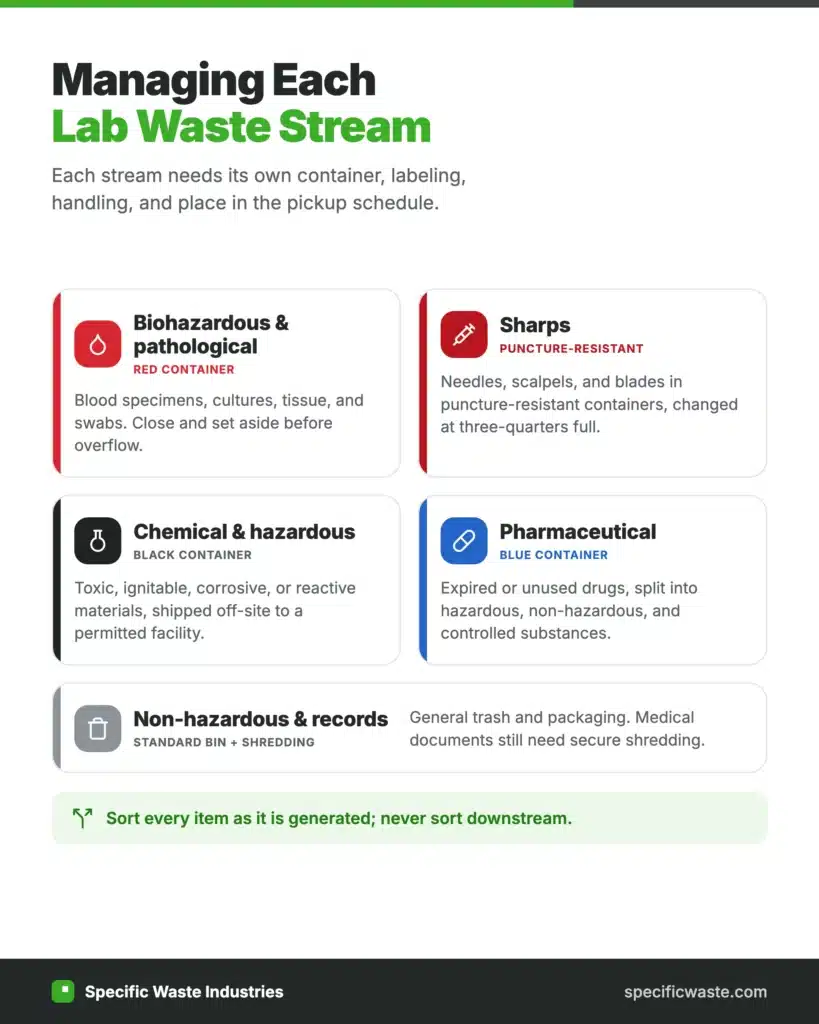
Each waste stream in a lab needs its own container, labeling, handling process, and place in the pickup schedule. Getting those specifics right at the point of generation matters more than any policy written after the fact, and it’s usually what an inspector checks first during a review. Below, we’ll break down what goes where and why it’s handled that way.
Biohazardous and Pathological Waste
Blood specimens, culture media, tissue samples, and contaminated swabs belong in red containers marked as medical waste, which are then closed and set aside for pickup before they overflow. Segregation has to happen as soon as the items are no longer in use because sorting it out later defeats the purpose and causes issues with compliance down the road.
Sharps
Needles, scalpels, suture needles, and other sharp instruments go into puncture-resistant sharps containers, and OSHA recommends changing those containers once they reach three-quarters full, well before they’re packed to the lid. For labs operating in remote parts of the state, or for smaller sites like acupuncture or tattoo studios with limited sharps volume, a mail-back program can be a more practical fit than scheduled on-site pickup.
Chemical and Hazardous Waste
Materials that are toxic, ignitable, corrosive, or reactive fall into this category. They are separated into black containers and transported off-site to a permitted facility rather than treated on the premises the way medical waste is. Solvents, acids, bases, and oxidizers all belong here, along with contaminated gasoline or diesel and compressed gas cylinders.
Pharmaceutical Waste
Expired or unused pharmaceuticals are split into hazardous and non-hazardous categories, plus a separate classification for controlled substances, and they’re typically managed with blue containers. Any labs running clinical trials or handling patient samples alongside pharmaceuticals need a process that keeps these categories separate from day one.
Non-Hazardous Lab Waste and Document Shredding
General trash, packaging, wrappers, and paperwork make up the bulk of a lab’s waste by volume even though they carry the least regulatory weight. However, medical documents still require secure destruction, and shredding services built specifically for medical records give a lab a defensible paper trail if a records request or an audit ever comes up.
Building a Disposal Program That Holds Up Long-Term
A program built to last survives staff turnover and passes inspection years after it was initially set up. That requires a much higher standard than just checking boxes month to month. Below are the habits that separate a program that’s built to endure from one that’s just getting by.
Segregate at the Source Every Time
Training staff to sort waste correctly the first time works better than counting on someone downstream to catch mistakes, and it’s the single biggest area of control a lab has over both cost and compliance risk. Clear signage at every bin helps, but it only works alongside real training.
Match Container Size and Pickup Frequency to Actual Volume
Pickup frequency options run from daily to weekly, bi-weekly, monthly, bi-monthly, quarterly, or annual, and the right choice depends on how much waste a lab actually produces, not merely a default schedule a vendor assigns on day one. A lab paying for weekly pickup when its volume only fills a container every three weeks is paying for capacity it doesn’t need, and a lab that generates overflowing bins well before the scheduled disposal day needs to readdress its current capacity levels.
Make Compliance Training Part of Onboarding
OSHA’s bloodborne pathogens training requirement is annual, not one-time, and new hires need it before they’re handling specimens unsupervised. Labs with high staff turnover, which describes a fair number of clinical and diagnostic settings, tend to see training gaps show up as the first thing an inspector flags.
Bring Every Waste Stream to One Provider
Juggling separate vendors for sharps, chemical waste, document shredding, and pharmaceutical pickups means juggling separate operational contracts and invoices too. When you work with more than one service provider, each new one added becomes another avenue where something can slip through. By using a single provider to handle multiple waste streams at once, you close off most of those gaps.
Compliance Mistakes That Show Up Most Often in Virginia Labs
A handful of issues account for most of the findings inspectors report after a review. Overfilled or improperly labeled containers top the list, closely followed by treating pharmaceutical waste the same way a lab treats general hazardous waste, when the two require different handling entirely. Working with a hauler who can’t produce documentation on request during an inspection creates its own separate problem, since recordkeeping gaps are treated as compliance failures in their own right. Smaller labs may even assume their volume is too low to be regulated at all, which is rarely the case once the actual monthly output gets counted.
What to Look for in a Laboratory Waste Disposal Partner
Signing on with the wrong provider often costs more than money down the line. When waste is improperly handled, it can leave a lab with compliance gaps, and those tend to surface during an inspection, not on an invoice. A few critical questions before signing tend to reveal those gaps early, when they’re still easy to fix.
Questions Worth Asking Before Signing a Service Agreement
Ask whether the provider treats waste in-house or hands it off to a third-party facility, since that answer affects both pricing and accountability. Additionally, ask whether pricing is itemized and whether containers are included in the service, rather than billed separately as an add-on. A vendor that can’t answer these questions clearly during the sales process usually can’t answer them clearly during an audit either.
Why In-House Treatment Changes the Pricing Conversation
When a provider treats its own waste and skips using a third-party facility, that removes a markup layer from the invoice. It also means fewer parties are involved in the chain of custody, which simplifies recordkeeping when a lab needs to show exactly where its waste went.
How Specific Waste Industries Supports Laboratories Across Virginia
Specific Waste Industries has spent more than 45 years working with healthcare and laboratory facilities across the Midwest and South, including Virginia, which means the regulatory landscape covered above isn’t new territory. The company treats waste in-house instead of routing it through a third-party facility, which keeps pricing transparent and invoicing straightforward with no hidden fees. Pickup frequency is built around what a lab actually generates rather than a one-size-fits-all package, with support for OSHA, EPA, DOT, and Virginia DEQ compliance requirements baked in as regulations shift. As a regionally owned and operated company, Specific Waste Industries offers the kind of personalized service large national players tend to standardize away.
Partner With a Team That Knows Virginia’s Lab Waste Rules
Virginia’s regulatory requirements for laboratory waste aren’t static, and neither are the waste volumes a growing lab generates. Specific Waste Industries brings decades of hands-on experience managing regulated medical, chemical, sharps, and pharmaceutical waste for facilities across Virginia, backed by in-house treatment and pricing that stays consistent from one invoice to the next. If you are interested in developing a waste disposal plan for your laboratory, whether it is a small independent lab or a large research facility, reach out today to talk through what it produces and at what volumes to build the perfect program.