

Key Takeaways
- Dental sharps and biohazard waste fall under different handling rules, though both count as regulated medical waste (RMW) in Virginia.
- Richmond practices answer to the Occupational Safety and Health Administration (OSHA) Bloodborne Pathogens Standard and Virginia’s Department of Environmental Quality (DEQ) regulations for handling and storage, while Department of Transportation (DOT) rules apply once waste ships out.
- OSHA’s standard doesn’t specify an exact percentage, but the fill line on most containers and standard industry practice call for swapping a sharps container once it’s about three-quarters full.
- Virginia allows small generators to store regulated waste on-site for up to 45 days or 250 gallons, whichever limit comes first, before it has to ship out.
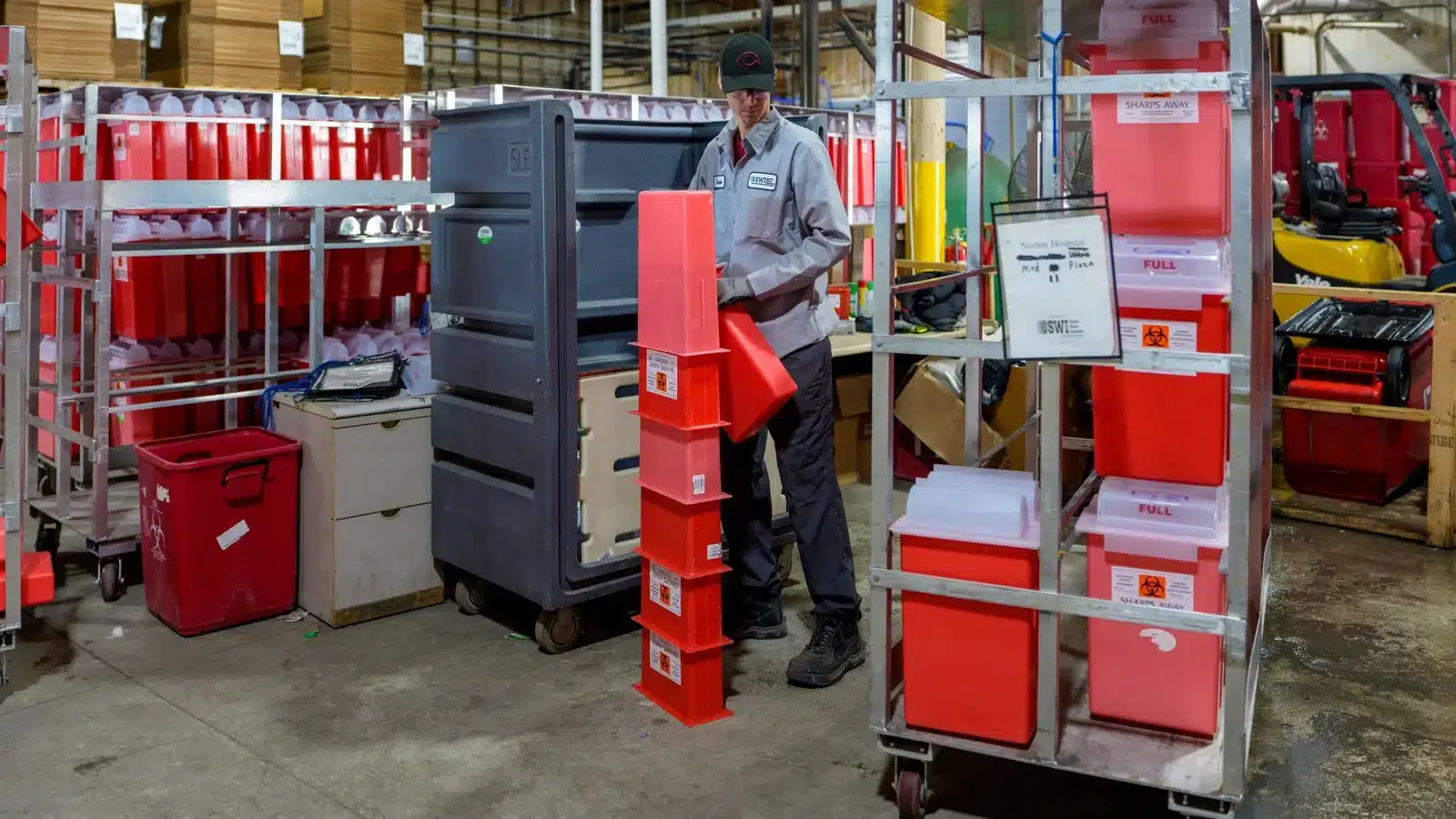
- A licensed regional partner such as SWI treats waste at its own facility, with pickup frequency set to match how much waste a practice actually generates.
A cleaning, a filling, an extraction, or a root canal all leave behind waste a dental practice can’t set out with the regular trash. This includes items like needles, scalpel blades, suture materials, and blood-soaked gauze, which become regulated materials the moment a provider sets them down. Once this standard is applied, Richmond dental clinics must answer to both federal rules and Virginia’s medical waste program to maintain health and safety standards. Get the handling wrong, and a practice risks a needlestick injury on one side and a failed state inspection on the other.
Dental sharps and biohazard waste disposal in Richmond follows a defined path, starting in the operatory chair and ending at a licensed treatment facility, and the clinics that manage it well tend to follow the same handful of habits. Specific Waste Industries (SWI) has worked with healthcare providers across the region for more than 45 years, and this guide breaks down exactly how the process works, starting with what counts as regulated waste and ending with who treats it.
What Counts as Sharps and Biohazard Waste in a Dental Office
Before a practice can manage its waste stream, staff need a shared understanding of what belongs where. Not every used item from a treatment room qualifies as regulated waste, and mixing categories is one of the more common compliance slips dental offices make. Getting this part right early makes every later step, including container choice and pickup scheduling, easier to manage.
Sharps Waste
Anything capable of puncturing skin falls into this bucket classification. In a dental setting, that typically means anesthetic needles, scalpel blades, suture needles, orthodontic wires, endodontic files, and broken glass from carpules. Once one of these items has been used on a patient, it belongs in a rigid, puncture-resistant sharps container, never a countertop tray or a pocket. OSHA’s container requirements, covered below, spell out exactly what “rigid” and “puncture-resistant” mean in practice.
Biohazard Waste
Sometimes called red bag waste, this category covers items that aren’t sharp but can still release blood or other potentially infectious materials (OPIM) if handled roughly. Blood-soaked gauze, saturated cotton rolls, extracted teeth, saliva ejectors, and gowns or masks stained with bodily fluids all belong in this category. The distinguishing test here isn’t how the item itself looks; it’s whether squeezing or bending it would release fluid or flaking dried blood. If it does, staff should bag it in a labeled, leak-resistant bag rather than the office trash can for compliance and safety.
What Doesn’t Belong in Either Category
A few waste types trip people up because they seem related but actually follow entirely separate rules. Waste such as dental amalgam is managed under the EPA’s Dental Effluent Guidelines rather than as regulated medical waste, and most practices handle it through an amalgam separator system. Meanwhile, expired or unused pharmaceuticals fall into a third bucket entirely. Under SWI’s color-coded system, pharmaceutical waste ships in blue containers, medical waste in red, and hazardous waste in black, keeping the streams separated from the moment they’re generated.
What’s at Stake When Waste Handling Slips
Improper handling of sharps and biohazard waste creates real physical risk for both staff and patients, and the numbers associated with it make that clear. Every year, it is estimated that healthcare workers sustain around 385,000 needlestick and sharps-related injuries in hospital settings alone, and dental staff face similar risks during cleanup and instrument processing. A stray needle in a pocket or an overfilled sharps container turns a routine procedure into an exposure incident, with hepatitis B, hepatitis C, HIV, and other bloodborne pathogens all on the list of what a single stick can transmit.
Staying Ahead of Fines and Liability
Beyond the obvious physical risks, Virginia’s DEQ has the authority to inspect and fine practices that mishandle regulated medical waste, and OSHA also carries its own penalty structure for bloodborne pathogen violations. This is where a compliance-focused waste partner comes in, ensuring your practice is on the right side of both agencies.
SWI delivers this protection through its compliance guarantee, centered on the singular goal of ensuring you never have to explain a violation to an inspector. Because a formal citation can also jeopardize future licensing reviews and insurance renewals, the true cost of noncompliance extends far beyond the amount of the initial fine.
The Regulations Richmond Dental Clinics Must Follow
National blogs on this topic tend to stop at generic advice about checking a state’s specific rules. In reality, Richmond practices operate under two active frameworks, plus a third that governs anything shipped off-site. Knowing all three, and how they overlap, keeps a practice from getting blindsided by a citation it never saw coming.
OSHA’s Bloodborne Pathogens Standard
Under 29 CFR 1910.1030, sharps containers have to meet four conditions: closable, puncture-resistant, leakproof on the sides and bottom, and labeled with the biohazard symbol or color-coded. Containers also need to sit close to where sharps are actually used, since OSHA expects sharps to be discarded immediately after use.
Virginia’s Regulated Medical Waste Management Regulations
Virginia’s DEQ administers 9VAC20-121, the state’s RMW rules, which were amended in March 2023. Of these regulations, one update matters directly for dental offices. After the Virginia Dental Association raised concerns about the cost of monthly container pickups, DEQ clarified that waste isn’t considered “stored” until a container is actually full and sealed. This means that practices generating less than 250 gallons of RMW per month can now hold that waste on-site for up to 45 days, whichever limit comes first. That flexibility replaced an earlier expectation of fixed monthly pickups regardless of how full a container was. However, once waste leaves the building, it still must go to a facility permitted for treatment or disposal. It can never go untreated to a solid waste landfill.
DOT Shipping Requirements
Once a licensed hauler picks up regulated waste, Department of Transportation rules control how it’s packaged and transported, adding a layer of federal oversight on top of Virginia’s state-level program.
How the Disposal Process Actually Works Day to Day
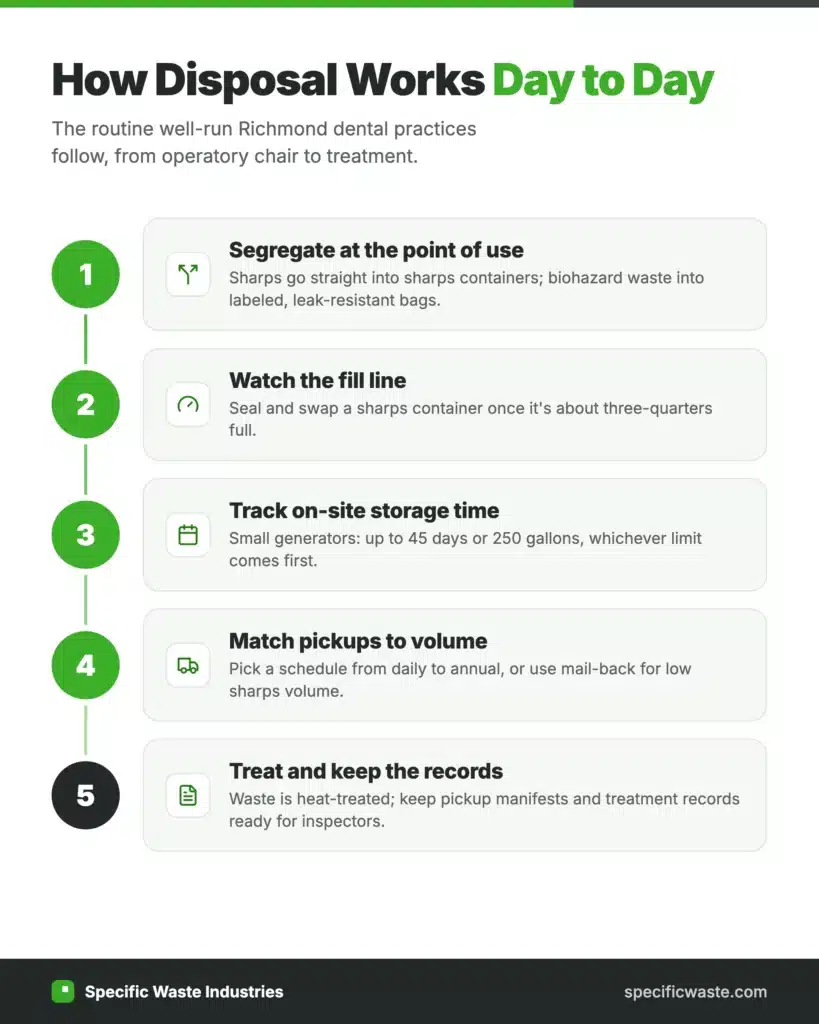
Knowing the rules is one thing, but running the process day after day is another. Here’s what that looks like inside a well-managed Richmond practice, laid out in the order it actually happens.
Segregate at the Point of Use
Sharps go into sharps containers the moment they’re set down, not at the end of the appointment, and biohazard waste goes into a labeled, leak-resistant bag. Letting either sit in an open tray or mixing the two is where most contamination and injury risk starts.
Watch the Fill Line
A container that’s about three-quarters full needs to be sealed and swapped out, then set off to the side for pickup. Waiting until it’s genuinely overflowing is a common mistake and a leading cause of preventable needlestick injuries.
Track How Long Waste Sits On-Site
Virginia gives small generators up to 45 days or 250 gallons of stored regulated waste, whichever limit is reached first, to send waste off-site, so practices do have some flexibility. However, that flexibility only works if someone actually tracks it. A practice that loses track of storage dates risks crossing a DEQ threshold without realizing it, compromising health and safety while triggering compliance violations and costly fines.
Set a Pickup Schedule That Matches Volume
Clients working with SWI choose how often waste gets picked up. Options include daily, weekly, bi-weekly, monthly, bi-monthly, quarterly, or annual pickups, plus a one-time visit for practices that only need a single collection. The right frequency depends on how much waste a practice generates, not on where it happens to sit on a map. The mail-back option fits smaller-volume sharps generators well, letting staff collect sharps and ship them out for treatment without a scheduled pickup route.
Treatment and Recordkeeping
Once waste reaches a licensed facility, it’s treated with high heat to neutralize infectious material before disposal. After proper disposal, practices should hold onto pickup manifests and treatment records. DEQ inspectors can and do ask for them during a compliance review, and having the paperwork organized ahead of time turns a stressful visit into a short and breezy one.
Common Mistakes That Show Up in Dental Waste Programs
A handful of simple missteps account for most of the compliance issues that turn up in dental waste programs, and none of them require a major overhaul to fix. They usually come down to a habit that slipped, or a schedule that never got updated after patient volume changed. These include:
- Letting sharps containers fill past the line before swapping them out.
- Dropping saturated gauze or contaminated PPE into the regular office trash rather than a red bag.
- Working with a national provider that doesn’t track Virginia’s specific storage and DEQ requirements.
- Skipping refresher training on proper item separation, so new hires learn incorrect habits from whoever trained them.
Choosing a Waste Partner for a Richmond Dental Practice
The right partner does more than just show up on schedule. To find a provider that fits your facility’s needs, look for one with direct experience in Virginia’s regulations, pricing that’s actually transparent instead of bundled with add-on fees, flexibility to adjust pickup schedules as patient volume changes, and hands-on compliance support when questions come up. A newer practice growing its patient base has different needs than an established office with a steady caseload, and a good partner keeps adjusting the plan as those needs shift, rather than locking a clinic into one fixed contract for years.
How Specific Waste Industries Supports Richmond Practices
SWI serves dental offices throughout Richmond, Short Pump, Midlothian, Chesterfield, and Henrico, providing the compliant medical waste disposal a practice requires to meet state and nationwide regulatory standards. This includes treating its own waste on-site, which keeps pricing competitive and transparent, with no hidden fees tacked on later. That pricing is set by how much waste a practice generates and how often it needs pickup, never by how far the office sits from a treatment plant.
For lower-volume generators, such as tattoo studios, acupuncture clinics, small specialty offices, and practices in more remote parts of the service area, the mail-back option fits well and is useful for those who want to stay compliant without having a scheduled pickup route.
Work With a Regional Partner Who Knows Virginia’s Rules
Richmond dental practices benefit most from a partner who deeply understands Virginia’s DEQ regulations and has enough field experience to know exactly where the process tends to break down. With more than 45 years of experience in compliant disposal, SWI delivers transparent pricing, in-house treatment, hands-on compliance support, and pick-up plans built around how each practice actually operates. Need a new provider to support your growing practice? Contact Specific Waste Industries today to talk through a sharps and biohazard waste program customized for your Richmond dental office.