

Key Takeaways
- The Virginia Department of Environmental Quality (DEQ) is headquartered in Richmond, and the Virginia Waste Management Board meets there to review and approve changes to the state’s medical waste regulations.
- Regulated medical waste that isn’t treated and transported correctly is a direct pathway for pathogens into soil and water. Virginia law separately prohibits sending untreated waste to a landfill in the first place.
- The regulation itself was recodified in 2023, moving from 9VAC20-120 to 9VAC20-121 under Amendment 3, with generator and transporter responsibilities clarified along the way.
- Richmond’s healthcare footprint, including VCU Medical Center, Bon Secours St. Mary’s Hospital, and HCA’s CJW Medical Center (Chippenham and Johnston-Willis), makes the region one of the state’s highest-volume generator hubs.
- Compliance requirements scale with how much waste a facility produces; Virginia draws its line at 250 gallons a month, not at how large or small a practice happens to be.
- A regional partner with in-house treatment and a sharps mail-back option closes gaps that tend to open up when waste changes hands across several third parties.
Richmond is Virginia’s capital, but it’s also something more specific: the headquarters city for the Virginia Department of Environmental Quality (DEQ), the agency that writes and enforces the rules governing how healthcare facilities across the state handle regulated medical waste. That proximity changes what compliance looks like for a clinic or hospital operating in the Richmond metro. Facilities here aren’t just following state environmental policy from a distance. They’re operating in the same city where that policy gets written, and their compliance record is part of how that policy actually functions.
Richmond Sits at the Center of Virginia’s Environmental Policy
Where a regulator sits shapes how fast its rules actually reach the people enforcing them. A facility ten minutes from an agency’s headquarters and one four hours away are bound by the exact same regulation, but they don’t experience it in the same way. Richmond’s position relative to Virginia’s environmental agency is a clear example of that gap, and it’s worth spelling out before getting into the rules themselves.
The Virginia Department of Environmental Quality Calls Richmond Home
The Virginia Department of Environmental Quality (DEQ) keeps its main office on East Main Street in Richmond. That’s also where the Virginia Waste Management Board holds its meetings and votes on changes to the medical waste rules that apply statewide. It was here that Amendment 3, the latest sweeping regulatory overhaul, was finalized before reshaping compliance across Virginia.
This proximity is far from symbolic. The people who draft updated compliance guidance, or field a question from a facility about a gray area in the rules, work out of Richmond. This means that while providers in other parts of the state can manage their regulatory relationship from a distance, Richmond-based facilities operate right on the regulator’s doorstep.
What Regulatory Proximity Means for Local Healthcare Generators
Being close to the agency that writes the rules has practical effects beyond convenience. Rule changes tend to reach Richmond providers with less lag, and Richmond facilities are frequently among the first in the state to feel the effects of an updated standard. Supporting Virginia’s environmental protection goals, in that light, isn’t a marketing phrase for a facility operating here. It’s a function of geography, and it comes with a level of scrutiny that facilities elsewhere in the state don’t necessarily face in the same way.
Why Medical Waste Compliance Is a Genuine Environmental Protection Issue
It’s easy to let “environmental protection” turn into a vague phrase that covers everything and settles on nothing. For a healthcare facility, however, the term has a narrower and more specific meaning, which centers on handling regulated medical waste correctly before it ever has a chance to become a hazard. The following sections explore both halves of that idea by looking at what is actually at risk when things go wrong and explaining what Virginia’s rules require to prevent those failures.
What’s Actually at Stake When Regulated Medical Waste Goes Untreated
Regulated medical waste, RMW for short, covers items contaminated with human blood or body fluids and cultures and stocks of microorganisms. It also covers sharps like needles and scalpels, along with tissue and other anatomical waste. When any of this is mishandled, the risk isn’t hypothetical. A landfill or an unpermitted disposal path can carry pathogens into soil and groundwater once untreated waste reaches it, which is precisely why Virginia’s regulations block that path outright. Untreated RMW cannot legally be sent to a solid waste landfill under any circumstances. It has to move instead to a facility permitted to receive it for transfer, treatment, or disposal.
This is worth stating plainly rather than gesturing at it or making general, untargeted claims. Mishandled medical waste creates a specific public health risk tied to pathogen exposure, not a vague environmental concern. Closing off the paths that risk would otherwise travel along is the entire point of the regulatory framework, and that’s a different function from sustainability messaging.
The Regulation Behind Virginia’s Medical Waste Rules
Virginia’s RMW regulation used to live under 9VAC20-120. The state repealed that chapter in 2023 and replaced it with 9VAC20-121, a recodification that came with updated definitions and modernized standards for treatment facilities. Generator and transporter responsibilities got clearer in the process too. What counts as RMW, how it has to be packaged and labeled, how long it can sit in storage before refrigeration kicks in, and what a treatment facility has to demonstrate to hold a permit are all covered under the new chapter.
A transition window gave existing permit holders time to adjust. Permitted transfer stations and treatment facilities had until September 2024 to update their applications to match the new chapter. For an individual generator, the practical effect was smaller but still real. Packaging and labeling rules shifted to sit under the new chapter number, and the segregation requirements moved right along with them.
Richmond’s Healthcare Sector and Its Compliance Footprint
Richmond’s healthcare sector has a substantial footprint that carries more weight than it might initially seem. Because the city contains such a high concentration of waste generators, local regulators must manage a live, high-volume portion of the state’s medical waste stream rather than a handful of theoretical cases. This massive scale fundamentally changes what compliance requires, though not in the way many facilities initially assume.
A Concentrated Hub of Generators, From Major Hospitals to Independent Practices
VCU Medical Center sits downtown, Bon Secours St. Mary’s Hospital operates on Bremo Road, and HCA’s CJW Medical Center spans two campuses, Chippenham and Johnston-Willis, on opposite sides of the city. Beyond the hospital systems, the metro area supports dental and veterinary practices, outpatient surgical centers, diagnostic labs, med spas, and long-term care facilities. And each and every one counts as a generator under Virginia’s definition of the term.
That density is exactly why compliance in Richmond carries weight beyond any single facility. A regulator headquartered in a city with this many generators isn’t managing a handful of theoretical risks on paper; rather, the day-to-day operations of Richmond facilities directly dictate whether Virginia’s entire statewide safety system succeeds.
What Changes as Generator Size Changes
Virginia doesn’t classify generators into named size tiers. Instead, the regulation draws a line at 250 gallons of RMW per calendar month. Facilities under that threshold have to arrange removal at least once a month and can’t store waste onsite for more than 45 calendar days. For generators producing more than 250 gallons, an even tighter schedule applies, which requires removal at least once a week, plus stricter facility standards for storage areas, including impermeable flooring and proper drainage.
An 800-bed hospital system and a single-provider dental office are both regulated under this same framework, just at different points on the volume scale. Being small doesn’t put a practice outside the rule. It only changes which side of the 250-gallon line the practice falls on.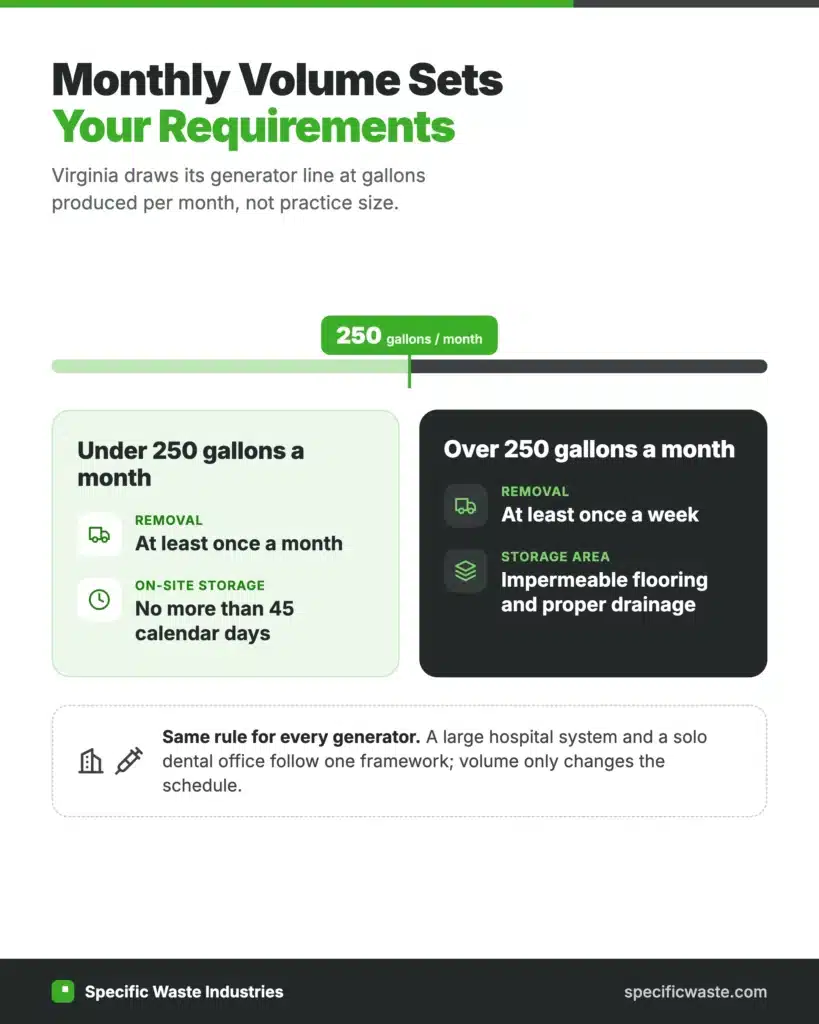
How Regulated Medical Waste Compliance Delivers on Those Goals
Compliance isn’t a box to check for its own sake; it is an active defense against real-world risk. Every piece of Virginia’s regulation maps onto a specific way medical waste could otherwise cause harm, beginning with rigorous treatment standards and extending through strict transport and tracking protocols. The sections below walk through each phase of the regulation, illustrating how day-to-day compliance directly supports and advances the stated goal of environmental protection and public safety.
Treatment Standards That Prevent Contamination of Land and Water
Compliant treatment means RMW gets treated with high heat before it enters any landfill or waste stream. That step neutralizes the pathogens that make the waste dangerous in the first place, and it’s the actual mechanism that keeps groundwater and soil protected. Treating waste with high heat serves a regulatory and public health function. Keeping that distinction factual, rather than folding it into sustainability messaging, matters, since the two categories serve different purposes entirely.
How RMW Has to Move From Pickup to Treatment
Once RMW leaves a facility, it has to be packaged to meet U.S. Department of Transportation (DOT) hazardous materials standards under 49 CFR Part 173. This federal regulation ensures that packaging remains sealed and intact for the entire trip. The regulations separately prohibit compacting or compressing RMW before it reaches a treatment facility, since doing so risks breaching packaging that was sealed specifically to prevent leaks and spills.
Alongside the physical handling of the waste, detailed and accurate documentation must track every step of the journey. Generators are required to keep records of RMW treatment or offsite shipment for three years, and that paperwork is what gives DEQ a way to confirm waste actually reached a permitted facility rather than disappearing somewhere along the route.
Why the Paperwork Is Part of the Compliance Picture
Recordkeeping can look like a formality layered on top of the real work, but it’s actually the backbone of compliance. Inspections and audits rely almost entirely on this documentation trail; for instance, a facility that receives RMW from offsite, a transfer station, or a treatment provider has to log the receipt date, the sending generator’s name, the amount received, and the date it’s later treated or shipped onward. Without that trail, DEQ has no practical way to confirm a facility’s waste stream was handled correctly, even when every physical step happened exactly by the book.
Where Richmond Facilities Run Into Compliance Trouble
None of this is complicated in theory. It gets harder to track in practice, however, because facility staff are busy running a practice or a hospital unit rather than monitoring regulatory filings, and the rules themselves don’t always move as one coordinated package. Below are two of the patterns that show up often enough in Richmond that they’re worth calling out directly.
Keeping Pace With Amendment 3 and Other Regulatory Updates
Regulations get revised, and Amendment 3 is the most recent example of a change substantial enough to affect daily operations. Because frontline facility staff are primarily concerned with patient care, they rarely have the time or resources to track Virginia Register filings or catch a recodification before it takes effect. This is why an internal policy written under the old chapter number can quietly go stale, and nobody notices until an inspection surfaces the gap.
One Set of Rules Doesn’t Cover Everything
Medical waste compliance in Richmond doesn’t run through a single agency. DEQ governs the environmental side of the equation, while employee exposure and bloodborne pathogen training fall under the Occupational Safety and Health Administration (OSHA), and transport packaging has to separately satisfy DOT rules. So, a facility can be fully compliant with DEQ’s standards and still fall short on the OSHA side, simply because the two sets of requirements were never designed to be tracked as one system.
Specific Waste Industries’ Part in Richmond’s Compliance Picture
This lack of a consolidated tracking system is where a compliance partner earns its keep. Specific Waste Industries built its service to fill in these gaps, and the sections below cover how that plays out in practice, starting with regulatory tracking.
Four and a Half Decades of Regulatory Know-How
Specific Waste Industries has spent more than 45 years working in this kind of regulatory complexity, which is why Richmond facilities can hand off tracking instead of monitoring it internally. Recodifications like Amendment 3 are one example. So are questions about which side of the 250-gallon line a facility falls on, and which packaging standard a shipment has to meet before it leaves the building. SWI also pairs its waste programs with OSHA compliance training, since a facility handling the DEQ side of compliance without the OSHA side is still only halfway covered.
In-House Treatment Instead of Third-Party Handoffs
SWI treats waste in-house rather than routing it through a separate third-party facility. Fewer handoffs mean fewer points where something can go wrong between pickup and treatment. That’s also part of how the company keeps pricing transparent, with straightforward invoicing and no hidden fees added after the fact.
Waste Programs Built Around Each Richmond Facility
Waste containers are available upon request for a separate fee and follow the industry’s usual color-coded system: yellow for chemotherapy waste, red for medical waste, black for hazardous waste, and blue for pharmaceutical waste. Clients choose their own pickup frequency rather than working around a fixed national schedule. A mail-back option is also available for smaller Richmond-area generators, such as tattoo studios or acupuncture practices, that don’t produce enough sharps waste to justify a scheduled pickup. That option was designed specifically for needles and sharps, and it tends to fit a practice generating waste in smaller, less predictable amounts better than a recurring pickup would.
Work With a Richmond Compliance Partner Who Already Knows the Rules
Getting RMW compliance right in Richmond means more than simply avoiding a fine; it actively upholds Virginia’s environmental protection framework, which relies heavily on the city’s central role to function correctly. At SWI, we work with healthcare facilities across the Richmond metro to manage compliance from pickup through final treatment, with transparent pricing and absolutely no hidden fees. By tailoring a regulated medical waste program specifically to your facility’s unique operational needs, we help protect both your budget and the local environment. Reach out for a quote today to see how a tailored waste program would work for your facility.