


Key Takeaways
- The OSHA Bloodborne Pathogens Standard (29 CFR 1910.1030) governs nearly every medical waste violation cited in a healthcare setting.
- Richmond medical practices answer to the Virginia Occupational Safety and Health (VOSH) Program, not federal OSHA directly, and the two rulebooks aren’t identical.
- Serious OSHA violations can carry a penalty of up to $16,550 in 2026, and willful or repeated violations can reach $165,514.
- Overfilled sharps containers and outdated exposure control plans are the issues we see most often in Richmond offices, closely followed by inconsistent staff training.
- A properly structured waste program, with the right containers, documentation, and training already built in, removes most of the guesswork for office staff.
Richmond’s healthcare sector is growing rapidly, and with its growth comes higher regulatory scrutiny. Between VCU Medical Center, Bon Secours facilities, HCA Henrico Doctors’, and an expanding roster of independent and specialty practices spread across the Fan, Short Pump, and Midlothian, few cities in Virginia have this dense a concentration of medical offices generating regulated waste. That density brings inspections, walk-ins, and audits that many office managers only think about after something has already gone wrong.
Compliance with the Occupational Safety and Health Administration (OSHA) isn’t a single rule to check off for a medical office. It’s an ongoing set of obligations tied to how waste gets classified, stored, labeled, and handled by staff who didn’t sign up to think about federal regulation every day. Get it right, and it barely shows up as a line item. Get it wrong, and the fallout negatively affects staff safety and the practice’s finances, with patient trust rarely far behind.
What OSHA Compliance Actually Means for a Medical Office
Before getting into Richmond-specific rules, it helps to understand what OSHA compliance requires at a fundamental level. These obligations exist for every employer, but the healthcare setting changes which standards apply and how closely inspectors look at them. The following sections lay that groundwork.
The General Duty Clause in Plain Terms
Every employer, medical or otherwise, has to maintain a workplace free of recognized hazards likely to cause serious harm. That’s the General Duty Clause of the Occupational Safety and Health Act of 1970, and it’s the baseline everything else builds on. A construction site might satisfy it by guarding a piece of machinery. A medical office usually satisfies it by controlling how staff interact with blood, sharps, and other potentially infectious material during a normal shift.
Why Medical Offices Face a Different Standard Than a Typical Workplace
A retail store or a law office rarely has to think about occupational exposure to bloodborne disease. A medical office does, simply because of the nature of the work happening inside it. That critical difference subjects healthcare settings to a set of stringent OSHA standards that most other industries never encounter.
The Standards That Come Up Most Often
Two standards apply to nearly every Richmond medical office to some degree. The Bloodborne Pathogens Standard governs waste and exposure risk, while the Hazard Communication Standard covers chemical safety data sheets and labeling. Personal protective equipment (PPE) requirements sit alongside both, and OSHA expects facilities to regularly assess how PPE is used and whether it’s still in good condition, since ill-fitting or worn-out protective gear defeats the purpose of having it at all.
Richmond Practices Answer to VOSH, Not Just Federal OSHA
Though federal OSHA sets the baseline, Richmond practices also answer to a separate, state-run enforcement body. Virginia operates its own occupational safety program, and that distinction matters more than most national compliance checklists suggest. The sections below cover what a Richmond office actually needs to know before treating a generic guide as authoritative locally.
What VOSH Is and How It Differs from Federal Enforcement
Most private employers and state or local government workers in Richmond fall under the Virginia Occupational Safety and Health Program, known as VOSH, rather than direct federal OSHA enforcement. VOSH sits inside the Virginia Department of Labor and Industry, and it has adopted the bulk of federal OSHA’s standards while layering on a handful of its own.
Compliance officers working for VOSH inspect facilities and issue citations much the same way federal OSHA does elsewhere in the country, so an inspection itself doesn’t usually feel much different. What changes is which specific rules actually apply, and what compliance standards must be met to avoid a fine.
Where Virginia’s Rules Actually Diverge
Here’s a detail most compliance guides tend to skip entirely. Federal OSHA’s standard for eye and body flushing facilities, found at 29 CFR 1910.151, includes subsections Virginia never adopted. VOSH only enforces subsection (c), which covers immediate access to flushing facilities for employees exposed to corrosive materials. This means that a medical practice copying a generic national compliance checklist word for word might end up chasing requirements that don’t apply here while missing something that does.
Compliance Elsewhere Does Not Guarantee Compliance in Virginia
A multi-location group with offices in several states can’t assume its compliance manual travels cleanly across state lines. What satisfies federal OSHA in one location may not map onto VOSH’s version of the same standard. This is why, when setting up any facility and its day-to-day operations, you must always include state-level regulations in your compliance planning.
The Bloodborne Pathogens Standard Governs Nearly Everything
Nearly every medical waste citation issued in a healthcare setting traces back to one rule: 29 CFR 1910.1030, OSHA’s Bloodborne Pathogens Standard. Roughly three million health care workers suffer a needlestick or puncture exposure to a bloodborne virus in an average year, which is part of why inspectors treat this standard seriously. It’s worth understanding in some depth, since it’s also the standard Specific Waste Industries spends the most time helping Richmond practices navigate.
What Counts as Regulated Medical Waste
Regulated medical waste includes:
- Sharps: This includes needles and lancets, along with items contaminated with blood or other potentially infectious material.
- Pathological Waste: For example, tissue removed during a procedure. It falls under the same standard and regulatory guidelines as sharps.
- Chemotherapy Waste and Pharmaceutical Waste: These categories carry additional handling requirements in addition to the bloodborne pathogens rules.
Specific Waste Industries treats all of these waste streams with high heat, which satisfies the disinfection requirement and the disposal requirement in a single step.
The Exposure Control Plan
A written exposure control plan is one of the most commonly missing documents during an inspection, and it’s also one of the easiest to have on hand. The plan identifies which job classifications face exposure risk and spells out the procedures staff follows to limit it. It also has to be reviewed and updated at least once a year, or whenever a new position or procedure changes the exposure picture. In the eyes of a critical inspector, a plan that nobody has touched since the practice opened is effectively considered no plan at all.
Training at Hire and Every Year After
Staff need bloodborne pathogens training before they start work in a role with exposure risk, then again every year after that. Training has to cover the epidemiology, or the root causes, of bloodborne disease and the practice’s own exposure control plan, among other required topics. Proper use of personal protective equipment gets covered too, since PPE failures are a common follow-up finding after an exposure incident. Skipping the annual refresher because “everyone already knows this” is a frequent shortcut, and it’s also an easily flagged gap that will be brought up at inspection.
Labeling, Color-Coded Containers, and Fill Limits
Container color tells an inspector, and a staff member, what’s inside without having to actually open anything. Yellow containers hold chemotherapy waste, red holds general regulated medical waste, black holds hazardous waste, and blue holds pharmaceutical waste. OSHA recommends changing a container once it reaches three-quarters full, since an overfilled sharps container is both a needlestick risk and one of the more obvious violations an inspector can spot during a walkthrough.
The Recordkeeping Requirement Most Offices Get Wrong
Under OSHA’s Bloodborne Pathogens Standard, a sharps injury log is only required for employers who must also keep standard injury and illness records under 29 CFR 1904. Because many doctors’ and dentists’ offices are exempt from that broader recordkeeping rule, they are also exempt from maintaining a sharps log, which may come as a surprise to those who believe this to be a ubiquitous standard. However, tracking sharps injuries remains a smart practice, since the underlying requirement depends on facts specific to each practice, and assuming an answer without checking is how offices end up either over-documenting or under-documenting incidents.
What Non-Compliance Actually Costs a Richmond Practice
Compliance can feel like an exercise in unnecessary paperwork until an inspection reveals a critical regulatory gap. At that point, the associated costs get real fast, and they often extend well past the citation number itself. The following breakdown shows what actually happens when a Richmond practice falls short, so you can create prevention methods ahead of time.
Current OSHA Penalty Amounts
As of 2026, a serious or other-than-serious violation can carry a penalty of up to $16,550. Willful or repeated violations climb to as much as $165,514 per violation, and a failure to correct a cited hazard adds up to $16,550 for every day the issue goes unresolved past the deadline. These figures apply whether the citation comes from federal OSHA or VOSH, since state plans are required to match federal maximums.
Costs That Show Up After the Fine
The fine itself is rarely the full cost of the problem. A citation typically comes with a mandatory corrective action plan, which pulls staff time away from patient care while the practice documents and implements fixes. Additionally, referral levels can be negatively impacted if word gets around that a practice failed an inspection, and liability exposure increases if an employee’s bloodborne pathogen exposure can be traced back to a documented gap in the previously established exposure control plan.
Why Small Practices Fall Behind on Compliance
Larger health systems tend to have compliance officers whose entire job is keeping documentation current. In comparison, a solo practitioner or small specialty office usually doesn’t have that role defined within their facility. This is due to time and staffing differences, since a smaller practice rarely has a dedicated compliance function the way a hospital system does. However, despite this disadvantage, the same rules apply regardless of practice size, which is exactly why smaller offices benefit most from a waste partner that handles the compliance-facing parts of the job for them.
Common Compliance Gaps We See in Richmond Medical Offices
Most violations we come across in Richmond trace back to a handful of predictable gaps that build quietly over time. These four show up more than anything else across the practices we work with locally, and none of them are complicated to fix once they’re on your radar.
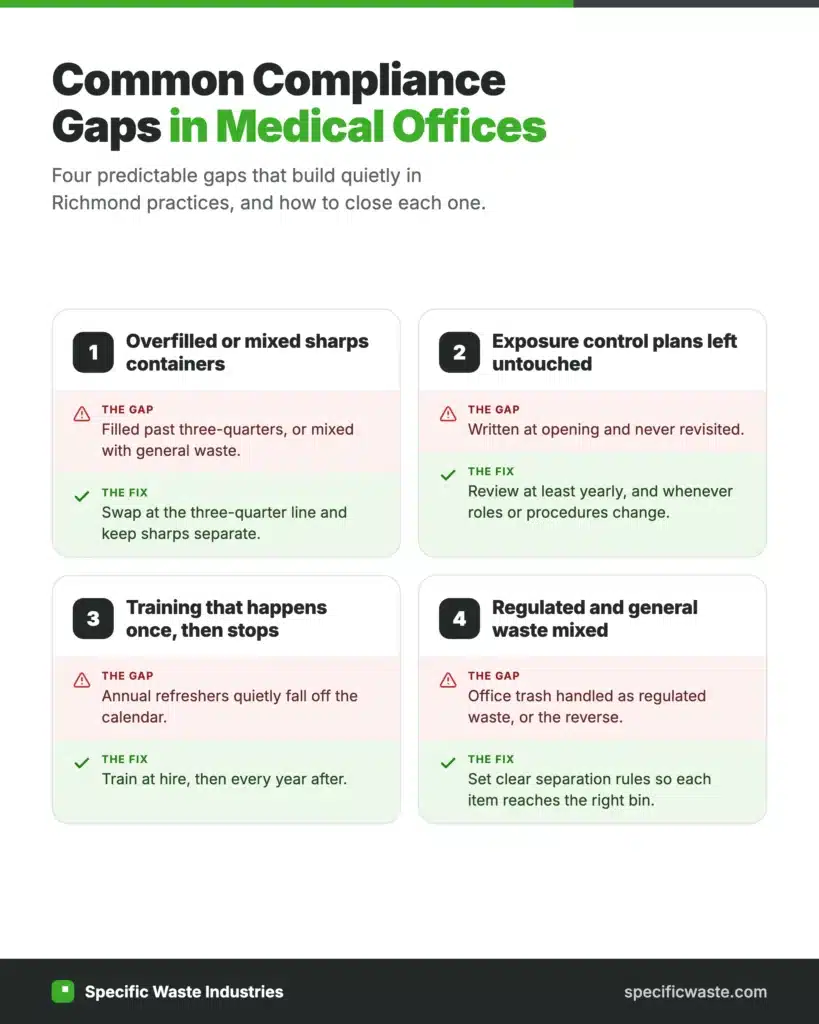
Overfilled or Poorly Segregated Sharps Containers
This is the most obvious issue and often the first thing an inspector notices. By leaving containers filled past the three-quarters mark, or by mixing in general waste with sharps, it creates both a safety hazard and an easy citation.
Exposure Control Plans That Never Get Updated
A plan written when a practice opened its doors and never revisited again doesn’t reflect who’s currently on staff or what today’s procedures actually look like. Annual review isn’t optional, and ignoring it is a fast way to receive a fine and need costly upgrades.
Training That Happens Once and Then Stops
Often, when new hires get trained, they are trained with the belief that new refreshers will happen periodically. However, as time goes by, the requirement can quietly fall off everyone’s radar until an inspection reminds the practice it was due months earlier.
Regulated and Non-Regulated Waste Mixed Together
This happens when practices treat general office trash as though it needs the same handling as sharps waste, or when they treat regulated waste as though it’s general trash. This mixing creates liability and increases the overall cost of proper medical waste disposal. Though getting separation procedures right takes some initial guidance, it isn’t complicated once a system is set in place.
Building a Compliance Routine That Actually Holds Up
Knowing the rules is the first part of the equation; building a system that keeps a practice compliant without constant attention is the second, and it’s where most day-to-day issues actually get resolved. The sections below outline what that looks like for a Richmond medical office.
What a Structured Medical Waste Program Includes
A program that functions day-to-day starts with the right containers already on-site, so the staff isn’t scrambling to source them. Specific Waste Industries can supply these containers as part of its service upon request (for an additional fee), along with a pickup frequency the practice chooses based on its own volume, whether that’s weekly, monthly, or somewhere in between. Documentation and training support are also provided, so compliance doesn’t rest entirely on one person remembering everything.
A Note for Smaller and Specialty Practices
Not every practice generates enough regulated waste to justify routine pickup service. A solo practitioner or small specialty office that produces sharps waste only, such as an acupuncture studio, may be better served by mail-back sharps disposal, which ships completed containers out for treatment without requiring a recurring collection schedule.
Questions Worth Asking Before You Sign With a Provider
Ask how pricing works before signing anything. A provider with its own in-house treatment process generally has more room to offer transparent, straightforward invoicing without surprise line items later on. Pickup frequency options are worth asking about too, since a practice with seasonal patient volume shouldn’t be locked into a schedule built for a much larger facility.
How Specific Waste Industries Supports Richmond Medical Offices
Specific Waste Industries has spent more than 45 years working with healthcare facilities on exactly this kind of compliance question, and that experience shows up in practical details clients can actually see on their invoice. Because SWI treats its own waste in-house, Richmond medical practices benefit from transparent pricing and highly customizable service plans without the markup a third-party treatment contract usually adds. This adaptability means Richmond practices get a program built around their actual waste volume, whether that’s a large multi-provider office near VCU or a solo practice in the Fan. This is further backed by comprehensive compliance training support and the flexibility to choose a pickup frequency that fits each facility’s needs.
A Final Word on Staying Compliant
Staying compliant means keeping up with the routine day after day, keeping containers current and training up to date even as staff turns over. Specific Waste Industries builds that routine alongside Richmond practices, spreading the responsibility beyond one office manager’s memory to a network of reliable, experienced team members. If your practice wants a waste program built around how you actually operate, reach out to Specific Waste Industries to put one together.