

Key Takeaways
- Paper records often contain complete identities, including names, addresses, dates of birth, policy numbers, subscriber IDs, and treatment details, making them attractive targets amid the hundreds of large-scale U.S. healthcare breaches reported annually, according to ongoing tracking by HHS OCR.
- Healthcare data breaches remain among the costliest of any sector, and medical identity theft can impose high out-of-pocket costs for patients.
- The Health Insurance Portability and Accountability Act (HIPAA) requires protected health information (PHI) to be unreadable and indecipherable before disposal. Secure shredding with a documented chain of custody meets that standard.
- Specific Waste Industries provides a compliance guarantee across HIPAA, OSHA, EPA, DOT, and state regulations, backed by 45+ years in medical waste management.
- Specific Waste Industries (SWI) offers transparent, competitive pricing. Because SWI treats its own waste in-house, you receive straightforward invoicing with zero hidden fees.
- Pickup frequencies include: daily, weekly, biweekly, monthly, bimonthly, quarterly, annually, or one-time.
Specific Waste Industries helps healthcare facilities close a frequently overlooked gap: the paper-based protected health information (PHI) that fuels identity theft and costly data breaches through secure, HIPAA-compliant medical document shredding. By pairing a rigorous chain of custody with certified destruction and audit-ready documentation, SWI lowers your exposure, protects patient trust, and stabilizes operating risk.
The Real Risk: Why Medical Documents Are a Prime Target
What Makes Healthcare Records So Valuable?
Medical records often include full names, addresses, dates of birth, insurance details, subscriber IDs, and elements of a care history. Together, that information constitutes a complete identity profile that commands a premium on illicit markets compared with isolated financial data. According to ongoing HHS OCR tracking, hundreds of large-scale healthcare breaches are reported each year, and many go undetected for months, leaving exposed PHI at heightened risk of misuse.
Unlocked file rooms, exam room printouts, and discarded paperwork that hasn’t been fully destroyed create preventable exposure. Secure shredding turns readable PHI into material that cannot possibly be reconstructed, eliminating a common source of unauthorized disclosure.
The Cost of a Medical Identity Theft Incident
The downstream impact is significant. Healthcare experiences some of the highest average breach costs of any industry, reflecting response, legal, remediation, and lost-business impacts. For individuals, medical identity theft can lead to significant out-of-pocket expenses and long-term effects on care access and credit that are harder to quantify.
The damage isn’t only financial. Investigations pull staff away from patient care, slow clinical operations, and erode community confidence. A disciplined document destruction program is a practical, measurable safeguard that reduces this risk at the source.
What Documents Must Healthcare Facilities Shred?
Patient Records and Clinical Documentation
Any paper containing protected health information (PHI) must be destroyed so it cannot be read or reconstructed. Common medical documents include:
- Patient charts and clinical notes
- Lab results and diagnostic reports
- Imaging reports and radiology summaries
- Prescription labels and medication administration records
- Vaccination records and consent forms
- Appointment schedules that display PHI
- Visitor sign-in sheets that contain PHI
Administrative and Financial Documents
Administrative and revenue-cycle paperwork frequently contains PHI and must be securely shredded when retention periods end. Examples include:
- Billing statements and invoices tied to patient accounts
- Insurance claims and prior-authorization paperwork
- Explanations of Benefits (EOBs)
- Remittance summaries and correspondence with payers
- Any printed report, list, or label with patient identifiers
HIPAA and Regulatory Requirements for Document Destruction
What HIPAA Requires
HIPAA requires PHI to be rendered unreadable, indecipherable, and not reasonably reconstructable prior to disposal. For paper records, that standard points to secure shredding performed under controlled conditions that produce irrecoverable output.
A compliant program documents the entire process. That includes written policies, staff training, a verifiable chain of custody for transfer and destruction, and proof of destruction, such as a certificate specifying the method, date, and volume. Partnering with a healthcare-focused shredding provider helps ensure these controls are carried out consistently.
The Consequences of Non-Compliance
HIPAA civil monetary penalties follow a four-tier structure based on the level of culpability, with per-violation amounts and annual caps adjusted periodically for inflation. Organizations should consult OCR’s current penalty schedule for exact figures. State privacy and breach-notification laws may create additional obligations and penalties.
Costs rarely stop at fines. Breach response, legal defense, patient notification and credit monitoring, operational disruption, and reputational harm all add to total exposure, contributing to multi-million-dollar totals.
How Specific Waste Industries’ Secure Shredding Process Protects Your Facility
Secure Collection and Storage
SWI helps you set point-of-use procedures so documents containing PHI are promptly segregated and kept under restricted access until destruction. By standardizing these steps, your team reduces the chance of unauthorized viewing or removal and supports consistent compliance across departments.
Scheduled Pickup and Chain of Custody
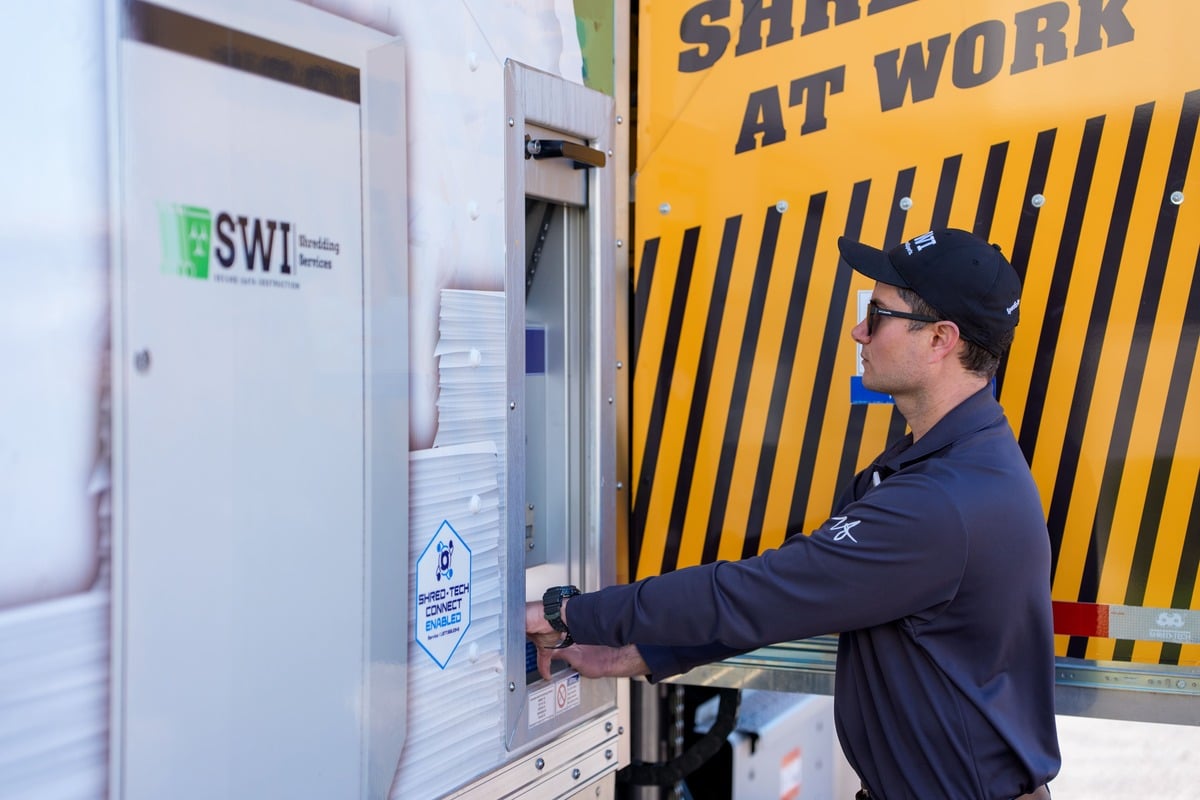
Trained SWI technicians maintain a documented chain of custody from collection through final destruction. Each custody transfer is logged to create a defensible audit trail.
Pickup frequency is aligned with your facility’s volume and risk tolerance, with options for daily, weekly, biweekly, monthly, bimonthly, quarterly, annually, and one-time.
Certified Destruction and Documentation
Materials are destroyed under controlled conditions so PHI is irretrievable. Upon completion, SWI issues a certificate of destruction that shows the date, location, and quantity, supporting audits and recordkeeping requirements.
Why Choose Specific Waste Industries for Document Shredding?
45+ Years of Medical Waste Expertise
For more than 45 years, Specific Waste Industries has worked exclusively in healthcare environments. That focus translates into survey-ready shredding programs designed around actual clinical workflows, thereby reducing friction while strengthening security.
The Compliance Guarantee
Your shredding program will be backed by SWI’s compliance guarantee across HIPAA, OSHA, EPA, DOT, and state regulations. From staff training guidance to audit-ready documentation, SWI builds regulatory safeguards into daily operations.
Transparent, Competitive Pricing
SWI delivers transparent, competitive pricing with no surprises. Because SWI completes its own shredding in-house, there’s greater control over the process, enabling the best pricing, straightforward invoicing, and zero hidden fees.
Tailored, Regional Service
SWI designs tailored shredding programs for hospitals, ambulatory centers, physician groups, dental practices, labs, imaging centers, and specialty clinics across the Midwest and Southern US. SWI provides waste containers and consoles as part of your program and aligns service frequency to your actual volumes to help you stay compliant while managing costs.
Protect Your Patients and Your Practice Today
Reduce breach risk at the source with a defensible, HIPAA-aligned shredding program for medical documents. Connect with an SWI compliance specialist to review your current process, right-size your pickup frequency, and receive a transparent, competitive quote tailored to your locations and volumes.