

Key Takeaways
- The average cost of document shredding in Richmond, VA, depends on five primary factors: volume, frequency, service type, compliance requirements, and media type (paper vs. electronic).
- On-site shredding supports witnessed destruction and strict HIPAA workflows; off-site shredding is typically more competitive for larger volumes while preserving the same chain-of-custody controls.
- Virginia Code § 54.1-2910.4 requires medical practitioners to retain health records for at least six years, with longer retention periods in specific cases, after which lawful destruction is required.
- Do-it-yourself (DIY) office shredding often costs more than expected once labor, equipment, and compliance-related exposure are factored in. DIY shredding also doesn’t include a certificate of destruction or formal chain-of-custody records.
- A certificate of destruction is provided after every Specific Waste Industries (SWI) shredding job and serves as verifiable proof during audits and inspections.
If you manage protected health information (PHI) in a Richmond, VA medical setting, you’ve likely asked, “How much does it cost to shred documents?” Pricing depends on the realities of your particular facility, including your document volume, pickup cadence, the destruction method, and the level of documentation your compliance program requires. This guide outlines the main cost drivers for Richmond healthcare providers, how common pricing works in the area, and why HIPAA-compliant shredding with a documented chain of custody and a certificate of destruction protects your organization.
Why Medical Document Shredding in Richmond Requires Specialized Services
Medical document destruction differs from general office paper disposal because it implicates federal and state regulations. The Health Insurance Portability and Accountability Act (HIPAA), the Federal Trade Commission (FTC) Disposal Rule under the Fair and Accurate Credit Transactions Act (FACTA), and Virginia-specific retention and destruction standards all apply. Across Richmond, PHI must be destroyed so that information is unreadable and irrecoverable, with every transfer documented through a chain of custody. Specific Waste Industries serves healthcare providers with HIPAA-compliant shredding for medical documents, transparent pricing, and detailed documentation after every job.
HIPAA, FACTA, and Virginia Compliance Obligations
HIPAA requires covered entities and business associates to implement reasonable safeguards so that PHI is permanently unreadable and unusable at the time of disposal. Paper records must be destroyed to a state that prevents reconstruction. For electronic protected health information (ePHI), the HIPAA Security Rule requires policies for final disposition and secure media sanitization. These standards shape how Richmond facilities select and manage shredding services.
The FTC Disposal Rule under FACTA requires businesses that handle consumer information to take reasonable measures to prevent unauthorized access during disposal. Medical offices that process consumer report data alongside PHI need a controlled destruction process staffed by trained personnel with secure collection and auditable documentation.
Virginia Code § 54.1-2910.4 establishes retention timelines for health records of at least six years following the last patient encounter (and up to 12 years from creation in many cases). Records for minors must be retained until the patient turns 18 (or is emancipated), with a minimum retention period of six years from the last encounter. After these periods, providers must ensure lawful destruction.
Virginia Administrative Code 17VAC15-120-30 identifies approved methods for destroying paper records, including shredding and pulping. For in-office destruction, a mechanical cross-cut shredder that reduces paper to no wider than 3/8 inch is specified. The regulation also emphasizes oversight for off-site destruction, the use of locked containers, bonded contractors, and formal documentation, including a certificate of destruction that lists what was destroyed, by whom, and on what date. These requirements illustrate the rigor expected across the full lifecycle of records management.
The Compliance Risk of Improper Document Disposal
Improper disposal of PHI poses a significant risk to Richmond healthcare facilities, with HIPAA penalties of up to $50,000 per violation, per incident. Enforcement actions frequently cite inadequate destruction controls, missing documentation, and lapses in the chain of custody. Beyond fines, the reputational fallout from a breach can erode patient trust, invite civil litigation, and trigger costly corrective action plans.
Certified shredding acts as a key control to reduce this exposure. Your provider should issue a certificate of destruction after every job, maintain a documented chain of custody from pickup to destruction, and use trained, background-checked personnel. These steps create a defensible audit trail, reassuring administrators, compliance officers, and counsel that required safeguards are active.
Five Factors That Affect How Much It Costs to Shred Documents in Richmond, VA
There’s no single “right price” for every Richmond medical office. Instead, the average cost of document shredding depends on variables unique to your facility’s records program: the volume generated, the service frequency, whether destruction occurs on-site or off-site, the required level of certification, and whether you also need electronic media destruction. Understanding these factors helps you forecast spending, compare quotes, and select the right plan with transparent pricing and no surprises.
1. Volume of Medical Records
Volume is the most influential cost driver. Shredding providers commonly price by the pound, by the banker’s box, or by the locked console or bin. As volume increases, the per-unit cost typically decreases due to economies of scale, though the total invoice increases with the total amount destroyed. Estimating your average monthly volume plus any seasonal spikes will help you choose the correct pricing model and service cadence.
Below is a quick reference to how volume commonly maps to pricing models in Richmond:
- Small (a few boxes): Priced per pound or flat drop-off rate (note: retail drop-off is not appropriate for PHI as it lacks a certificate of destruction)
- Medium (10–50 boxes): Priced per box or per bin/console with secure pickup
- Large / Ongoing: Priced by monthly flat rate per secure console with scheduled pickups
Practical tip for Richmond healthcare administrators: Complete a brief volume assessment by counting boxes generated in a typical week, noting retention releases (such as after records reach their legal thresholds), and identifying archival backlogs. This baseline speeds up quoting and aligns your bin counts and pickup frequency to your real-world workflow.
2. Frequency of Service: Routine Pickup vs. One-Time Purge
How often you need shredding also shapes cost. Scheduled service (daily, weekly, biweekly, monthly, bimonthly, quarterly, or annually) generally reduces the per-visit rate because pickups are routed more efficiently. Your provider places locked consoles or bins throughout your facility, collects on your chosen schedule, and documents each stop, streamlining both cost and compliance.
A one-time purge, such as clearing out archived medical files after retention thresholds are met or consolidating closed charts during an electronic health record (EHR) transition, is priced as a standalone job. This usually carries a higher per-visit rate than recurring service because routing, truck capacity, and labor must be dedicated to that single event. Many Richmond facilities use a hybrid model: recurring pickups for day-to-day generation plus periodic purge events when legacy records are released.
3. Type of Service: On-Site vs. Off-Site Shredding
Richmond providers commonly choose between on-site (mobile) shredding and secure off-site shredding. Both methods are HIPAA-compliant when performed by a certified medical document destruction partner that provides a chain of custody and a certificate of destruction. The right choice depends on your facility’s volume, internal policies for witnessed destruction, and budget targets.
Consider these practical differences:
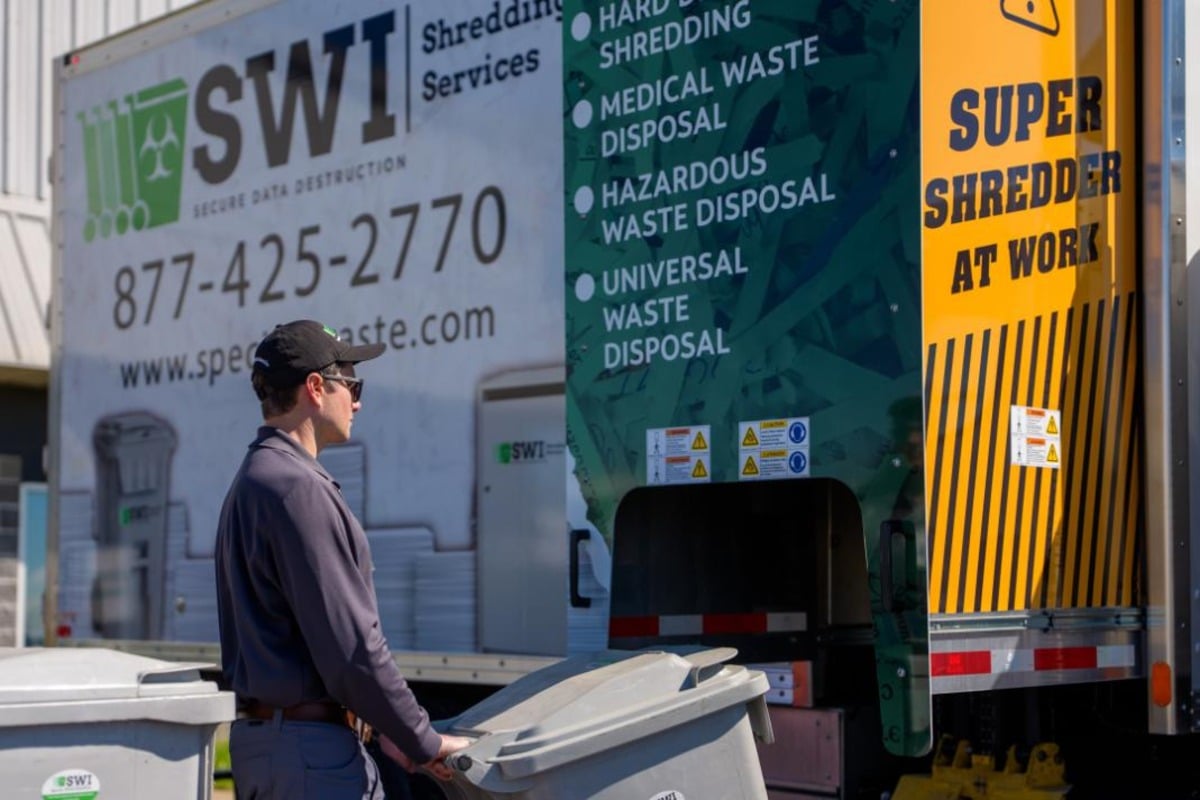
- On-site (mobile) shredding: A shredding truck arrives at your Richmond facility, loads locked containers, and destroys medical documents on location. Destruction can be witnessed in real time by your staff. Cost Implication: Typically higher due to specialized mobile equipment and on-location processing. Preferred by facilities that require witnessed destruction as part of their compliance protocols.
- Off-site shredding: Documents are collected in locked containers and transported in GPS-equipped, DOT-compliant trucks to a certified shredding facility for industrial destruction. Cost Implication: Generally more competitive for larger volumes while maintaining equivalent chain-of-custody controls. A certificate of destruction is provided after completion.
Whether you choose on-site or off-site, insist on documented custody from pickup through final destruction; trained, background-checked personnel; and itemized invoices that clearly reflect your service plan.
4. Compliance and Certification Requirements
HIPAA-compliant destruction by a certified provider includes not only shredding but also the infrastructure and documentation that protect you during an audit. Expect a formal chain of custody; locked, barcoded containers; trained, background-checked staff; and a certificate of destruction with each job. These safeguards add cost relative to retail drop-off options but are necessary for medical documents containing PHI.
Retail drop-off locations marketed to general consumers (such as office supply stores) typically charge per pound and don’t provide a certificate of destruction, nor do they offer the documented chain of custody medical facilities require. For Richmond healthcare providers, retail drop-off is not an appropriate pathway for PHI and should be avoided.
5. Electronic Media and Hard Drive Destruction
Many Richmond facilities need digital media destruction as well as paper shredding. Hard drives, CDs, DVDs, and backup tapes containing ePHI require specialized destruction equipment and processes that differ from paper. Pricing for electronic media is usually per unit, with volume discounts at higher quantities. The most efficient approach is often to bundle media destruction with recurring paper service so pickups, documentation, and invoicing are consolidated under one compliant program.
Ask how your provider verifies media destruction (for example, by logging serial numbers for hard drives) and how this appears on your certificate of destruction to ensure a complete audit trail.
Understanding the Average Cost of Document Shredding in Richmond, VA
When healthcare leaders research the average cost of document shredding, they’re seeking a reliable benchmark for budget planning. While every Richmond, VA facility is different, several common pricing structures appear across the market. Use the following ranges as directional guidance; final pricing should reflect your exact volume, frequency, service type, and compliance requirements.
Transparent Pricing for Your Richmond Facility
Predictable, line-item invoices make compliance budgeting manageable. Hidden fees and ambiguous service lines are common pain points with large national shredding vendors. Richmond healthcare administrators benefit from transparent pricing that clearly states what’s included and what each line item costs. No fuel surcharges that appear without notice, no add-on fees for basic documentation, and no vague descriptions.
SWI provides competitive, transparent pricing from the outset. Quotes are itemized around your chosen frequency, bin counts, service method, and any electronic media destruction. This clarity simplifies approvals, reduces back-and-forth, and ensures there are no surprises on the invoice.
The Hidden Financial Risks of DIY Office Shredding
At first glance, buying an office shredder and assigning staff to feed it might appear cost-effective. In reality, DIY programs tend to cost more than planned and introduce compliance gaps that Richmond facilities cannot afford. If your process doesn’t create a chain of custody or generate a certificate of destruction, you lack the documentation auditors expect.
Additionally, if your shredder doesn’t meet minimum cross-cut standards, your output may not meet HIPAA’s requirement for unreadable, irrecoverable disposal.
The True Cost of Employee Labor and Equipment
Consider the cumulative cost of in-house shredding. A staff member earning $20-$25 per hour who spends just 20 minutes each workday shredding documents can generate $1,500-$2,000 in annual labor expense before factoring in benefits and overhead. Multiply that across several staff members, and you can exceed the annual cost of a professional program.
Add equipment costs: purchasing shredders, emptying and cleaning them, clearing jams, repairing or replacing units, not to mention securely disposing of shredded material. Small office shredders aren’t designed for continuous, high-volume feeds typical in medical settings. Downtime and maintenance become recurring drains on productivity and the budget.
Security Vulnerabilities and Compliance Exposure
Many consumer or light-duty office shredders produce strip-cut output that can be reconstructed, falling short of HIPAA’s requirement to render PHI permanently unreadable. Even cross-cut models vary widely in particle size. Without a verifiable standard, DIY shredding opens a compliance exposure you may not detect until an audit.
Equally important, DIY programs cannot produce a certificate of destruction or maintain a formal chain of custody. If an incident occurs, such as a misplaced bag of shredded material, an unauthorized access event, or a question from an auditor, you may lack the records needed to defend your process. A certified medical document destruction service closes these gaps with documented custody and verifiable destruction records.
Virginia Medical Record Retention and Destruction Laws
Sound policy starts with knowing what the law requires. For Richmond healthcare providers, two Virginia authorities shape how long you must keep records and how you must destroy them once retention periods end. Understanding these standards helps align your destruction schedule and supports clean, defensible audits.
Virginia Code Requirements for Record Retention
Virginia Code § 54.1-2910.4 requires medical practitioners to retain health records for at least six years following the last patient encounter and, in many cases, for up to 12 years from the date of creation. Records for minors must be retained until the patient turns 18 (or is emancipated), with a minimum retention period of six years from the last encounter. Once the applicable retention period expires, secure destruction is expected to prevent unauthorized access to PHI.
In practice, Richmond facilities often set quarterly or semiannual destruction cycles aligned to these thresholds. Coordinating regular releases keeps storage under control, prevents space constraints, and ensures records aren’t kept longer than necessary, thereby limiting liability while staying compliant.
Approved Destruction Methods Under Virginia Law
Virginia Administrative Code 17VAC15-120-30 identifies approved approaches for destroying paper records, including shredding and pulping. If destruction is performed in-office, the code specifies a mechanical cross-cut shredder that reduces paper to a maximum width of 3/8 inch. For off-site destruction, the code underscores the importance of locked containers, bonded contractors, proper witnessing, and a formal certificate of destruction documenting what was destroyed, who destroyed it, and the date.
For electronic records, best practices recognized in Virginia include overwriting or otherwise rendering data irrecoverable; physical destruction of certain media (such as optical discs) is also a recognized solution. A certified provider can document these steps alongside your paper destruction within a single chain-of-custody framework and certificate of destruction.
Secure Medical Document Destruction for Richmond Healthcare Providers
Specific Waste Industries designs medical document destruction programs around the way Richmond facilities actually operate. Whether you’re a hospital, clinic, private practice, pharmacy, dental office, or nursing home, your destruction plan should map to your retention cycles, space constraints, compliance posture, and staffing realities. With 45+ years of serving healthcare across the region, SWI aligns service frequency, bin placement, and destruction method with your actual volumes before putting everything in writing with transparent pricing.
A Tailored Approach for Richmond Medical Facilities
Our process begins with a brief consultation to confirm what you generate, how often you need pickups, and whether on-site or off-site destruction best matches your compliance preferences. We place secure, locked containers in designated areas, schedule pickups at the cadence you choose (daily, weekly, biweekly, monthly, bimonthly, quarterly, or annually), and manage transportation using GPS-equipped, DOT-compliant trucks.
Destruction occurs either at your site with a mobile shred unit (witnessed by your team if preferred) or at a certified facility under a documented chain of custody. Upon completion, SWI issues a certificate of destruction for your records. If you also need electronic media destruction, we integrate it into the same program, so you receive unified documentation and invoicing.
To learn more about program options, visit our document shredding, medical waste disposal, and compliance page for detailed regulatory insights tailored to Virginia providers.
Why Richmond Healthcare Facilities Choose Specific Waste Industries
- Unmatched Experience: With over 45 years of experience in medical waste and document destruction, SWI understands the operational realities and regulatory requirements that govern healthcare providers in Richmond, VA.
- Competitive, Transparent Pricing: Because we handle services in-house rather than outsourcing, we offer competitive pricing and straightforward, itemized invoices with no hidden fees.
- Compliance You Can Prove: We maintain a documented chain of custody at every step and provide a certificate of destruction after every job, which is key evidence during HIPAA and state-level audits.
- Tailored, Regional Service: As a regional partner, we adapt to your facility’s rhythm with flexible scheduling. You select the frequency, and we align routing and resources to support your team without disrupting patient care.
Ready to establish a compliant, transparent shredding program for medical documents in Richmond, VA? Contact Specific Waste Industries to request a quote and align service, documentation, and pricing to your facility’s needs.