

Like many businesses in Virginia, healthcare organizations in Richmond have clear legal obligations surrounding medical waste. The Virginia Department of Environmental Quality (DEQ) governs how regulated medical waste (RMW) is handled from the moment it’s produced to its final disposal. In particular, Virginia’s Regulated Medical Waste Management Regulations govern the standards for storing, packaging, and transporting medical waste.
Specific Waste Industries (SWI) has over 45 years of experience navigating these requirements for medical facilities across Virginia. Our team knows what compliance looks like at every stage of the waste stream, and we’re here to keep your business from finding out what non-compliance costs.
What Virginia Defines as RMW
Not all waste generated in a clinical setting is considered to be RMW. Virginia’s DEQ draws a specific line, and knowing where it falls is the first step toward managing your waste program correctly.
RMW in Virginia includes the following categories.
- Sharps: Needles, syringes with attached needles, scalpels, broken and intact glass, lancets, culture dishes, acupuncture needles, and more.
- Human blood and body fluids: Blood, serum, plasma, and items contaminated with human blood or effluvia that would release liquid or semiliquid blood if compressed.
- Pathological waste: Human pathological and anatomical waste, including body tissues, organs, and body parts.
- Cultures and stocks: Discarded cultures, stocks of microorganisms, vaccines, and wastes from the production of biologicals.
- Animal waste: Animal carcasses (and related wastes) when animals are infected with organisms likely to be pathogenic to humans.
It’s important to note that sharps and pathological waste have separate handling and disposal requirements, but they are legally subsets of RMW under Virginia law, not separate parallel categories.
Generator Classifications and Storage Limits
The regulations governing medical waste in Virginia differ based on how much waste an organization produces each month, so knowing your generator classification is crucial.
- Small generators, or those producing less than 250 gallons of RMW per calendar month, must arrange for the removal of all stored waste at least once per month. No more than 250 gallons may be stored on-site at any time, and waste can’t remain on-site for more than 45 calendar days regardless of volume.
- Large generators are those producing 250 gallons or more per calendar month. They are subject to more frequent removal requirements. These facilities must remove all stored waste at least once per week, and no waste may be on-site for more than 10 calendar days.
Across both classifications, all RMW must be stored in a way that ensures its packaging doesn’t break, prevents spills, and protects the waste from the elements and unauthorized access.
Packaging, Labeling, and the Color-Coding System
Packaging and labeling are where a lot of facilities slip up. In Virginia, all RMW must be packaged and labeled on-site before it’s stored, moved, or transported off-site, and the requirements are specific.
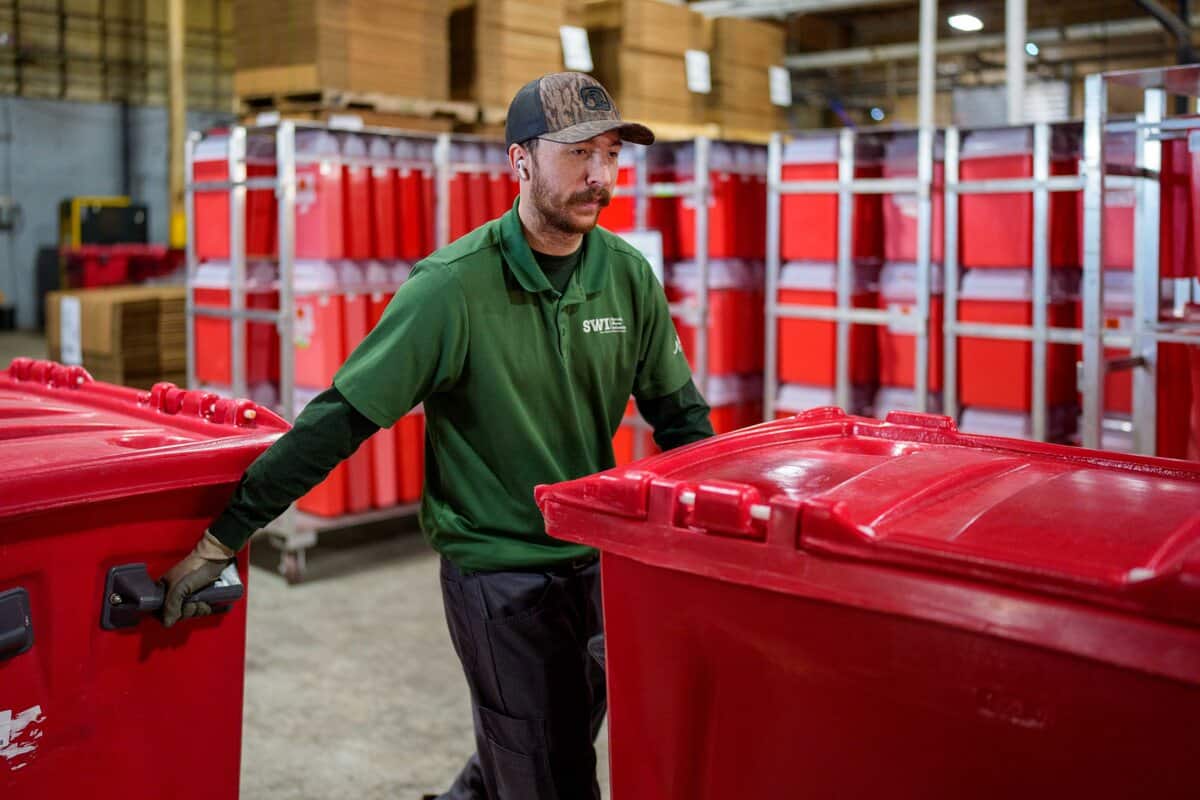
All RMW must be placed in bags or containers that are closable, leak-resistant, and constructed to hold all contents securely. Virginia uses a color-coded container system to distinguish waste streams at a glance.
- Red containers: Used for RMW
- Yellow containers: Used for chemotherapy waste
- Black containers: Used for hazardous waste
- Blue containers: Used for pharmaceutical waste
Sharps get their own set of rules. They must go into puncture-resistant containers, and OSHA recommends swapping them out when they’re ¾ full.
Once a bag or a container is full, it must be closed and sealed before it’s moved. Every package of RMW must display a label with the generator’s name, address, and business phone number, along with the words “Regulated medical waste,” “Biohazard,” or “Infectious waste,” plus the universal biohazard symbol. For hospitals, the label must also identify the specific department or lab where the waste originated.
Before RMW leaves your facility for off-site disposal, it must also be packaged in compliance with the U.S. Department of Transportation Hazardous Materials Regulations.
The Cost of Non-Compliance
Civil penalties for DEQ violations run up to $32,500 per day per violation, and those fines accrue daily. A single unresolved issue can quickly compound into a six-figure liability. Willful violations and repeated offenses can lead to criminal charges, and failure to pay assessed fines can result in asset seizure, a lien on the commercial property, and other penalties.
In cases of DEQ enforcement, the Enforcement Liaison Office creates a record of the action. For hospitals, clinics, and research facilities in Richmond, this kind of public knowledge can harm their reputations and clients’ trust, making it essential to maintain strict regulatory compliance at all times.
The straightforward protection against all these issues is a compliant waste management program with a permitted, experienced disposal partner.
How SWI Helps Healthcare Facilities Stay Compliant
SWI is a regionally owned and operated company serving medical facilities across Virginia, including Richmond and the surrounding areas of Short Pump, Midlothian, Chesterfield, and Henrico. Since we have our own medical waste treatment facility, we offer the best possible pricing without hidden fees.
Our services are designed around your schedule. We help you select a pickup frequency that suits your operational flow, with options such as daily, weekly, bi-weekly, monthly, bi-monthly, quarterly, annual, and one-time pickups. Pricing is transparent from the moment you receive the upfront quote, invoicing is straightforward, and there are no surprises.
We handle the full range of waste streams produced by healthcare businesses in Richmond. Medical waste and chemotherapy waste are treated with high heat, and hazardous waste is transported safely for final disposal. We can help you select the right container types and quantities and offer a convenient mail-back option for sharps disposal. Shredding services are available for medical documents.
Compliance is our number one goal. Our team offers comprehensive OSHA compliance training and works directly with hospitals to ensure regulatory adherence, so your staff understands all relevant regulations and your facility stays ahead of inspections. Contact our team today, and let’s work together.